As mentioned in my previous blog that the standards in Speakers Corner to be ‘charitable’ have declined over the last three or four years. Dialogues and discussions have taken a back seat to mocking and insults. With the greatest of respect to those that attend the park, they do not command the English to an apt level or have a greater understanding of the subject matter which they look to defend. This goes for both Muslims and Christians. There are exceptions to the above; brother Hashim, brother Mansur, brother Adnan Rashid, brother Mohammed Hijab, Samsun, Colin and the Christian Sister (with the brown hair) have demonstrated the ability to have polemical discussion without trading insults.
Moving on, we (the Muslim’s) unequivocally condemn the attack of any women, be it in the park or outside. I don’t think I stand alone in this position, nevertheless, it is very important that we condemn that attack on Hatun (Hatun Tash). I note the regular esteemed speakers in the park like Mansur, Sheikh Mohammed and Hashim have already condemned this action.
Before we continue, the behaviour of Hatun, is not in any way, shape or form, a reflection of many millions of Christian’s across the world. Rather, my interaction, with Christian have always been positive. Whilst we disagree vehemently on matters pertaining to the Trinity and Oneness of god; we draw many similarities then differences in humanity. Many Christians are genuine, sincere, god fearing, compassionate and loving people. Nothing which resembles the Christian missionaries in the park unfortunately.
It is very important to understand that the attack on Hatun last week was allegedly committed by a Christian. This should be no surprise, whilst Muslims have been victim of her vile rants and offensive behaviour, it is the ultimate Christian community which have taken the most offence. Like Muslim’s have been held ransom by ISIS, the Christians have been held ransom by DCCI. Many Christian radio stations in the UK refuse to have members of DCCI on their stations. It was only a couple of weeks ago an Eritrean Christian sister called out Hatun and other missionaries for their attacks on Muslims in the parks. If you look at the comments sections on YouTube, many Christian’s have also distanced themselves from Hatun and DCCI.
Hatun Tash- Preaching Christianity or attacking Islam?
Hatun (Christian Missionary) has been a regular at the park for the last five years. She is part of DCCI, a group led by their leader Jay Smith (a known Islamaphobe), whose life mission has been to attack Islam. Jay Smith has been dismantled by several Muslim polemics including Shabir Ali. Like Jay Smith there is nothing genuine about Hatun’s opposition to Islam, rather her position is to mock Islam through a lack of understanding of Islam text through isolated verses of Quran, Hadith and Tafsir. Even when corrected, she will shout from the top of her voice, repeatedly, until you are forced to leave the ‘discussion’. This may be considered a victory, but those with intellectual insight, will free themselves from this conversation.
Freedom of Speech or Freedom of Expression in the Park? Which has the absolute right?
As we all know, Speakers Corner is the epitome of Free of Speech. Hatun has the right to say whatever she likes, irrespective of who she offends, this is an absolute right which is persevered in the park. I have my own view to the contrary but nevertheless let’s not digress. Her actions with respect to the pictures (depicting Allah and his messenger) and the holes in the Quran, are no long covered under free speech, rather her actions manifest under the freedom of expression? We see a double standard here, a couple of years ago, the police banned the Muslim’s from praying in the park, an interpretation of the law was applied and enforced. Yet, when Hatun mocks the Quran for the past couple of weeks, the law enforcement have not applied their interpretation of the law to prevent Hatun from acting on her Freedom of Expression to provoke Muslims.
Can Hatun be relied upon?
Spare the rhetorical nature of the question- the answer is no. I will not bore you with too much information here. The veracity of her attacks on Islam (as vile as they are), hold no weight. She neither can read or speak Arabic; I do not believe she can read the Arabic alphabet (no insult intended). The reality is, the Quranic language is different to what is translated in to English. For this reason, Non-Arab Muslims are strongly recommended to learn the Arabic language. There are other arguments, for example the context and the corpus-linguistics of the Arabic language of that time, which make it impossible for a layman to critique the Quran and it’s supported text unless they have a command of the Arabic language.
Other than being grammatically poor- The reality is, Hatun’s arguments have been dismantled over the years by Muslim da’ees in the park. She has been reduced to insults and provocative behaviour to trigger a reaction. As elementary as this maybe, when your left with no academical argument, the next best thing to do is provoke, to re-enforce a negative stereotype.
Hatun is a vile human being who has nothing but hate for Allah (swt) and his Messenger (pbuh). There is nothing academical in her rants, the fact that she is a Christian and refuses to preach her own faith whilst obsessing about Muslims, just about tells you everything in respect to her own-belief system.
The Solution!!!
If you are not thick skinned or intellectually apt to refute Hatun’s spiel, desist from all conversation or interaction from Christian Missionaries in the park. Our elders in the park (Mansur, Hashim and Adnan) have done the same, we should also follow them in this. Naturally, when they are not receiving a response, they will be forced to stop!!! Please do not harm or attack DCCI as this what they want you to do!!!
This week it is rumoured that Tommy Robinson (a known Islamaphobe) will be looking to attend the park this Sunday to support Hatun. This should not the Muslims as we are aware Jay Smith is bosom buddy’s with Tommy Robinson, Whilst this is considered a victory for Hatun, unfortunately, being linked to a known Islamaphobe only re-enforces the stereotype that Hatun and DCCI are linked with extremist!!
Finally- for the younger generation of Muslims who have a zeal for their religion and want to protect their faith, please do not come with this mob mentality, follow Hatun or attack her. This is not a place to become YouTube famous. Rather spend your time either learning the religion, being more versed in the English language or learning from elders (Hashim, Mansur and Adnan Rashid) in the park by listening quietly in their discussions.
This is the second part of a four-part series covering the
life of Umar-Ibn-Khattab (r.a) – Umar (r.a) life is one which is relatable for
people from different warps of life, be it Muslim or Non-Muslim. This blog will
go in to further detail of how influential his life was as a person, believer
and a leader. The truth is, the life of Umar (r.a) is so interesting, it can
prove a difficult task, in choosing, what should be put in to this blog and
what should not. I will try to do justice to Umar (r.a) Inshallah.
Please note- These blogs are bite-size pieces of information
regarding the lives of the Sahabas. I strongly recommend reading a Sira
(biography) of his life, or maybe listening/attending a lecture to get more
information about their lives.
Umar-Ibn-Khattab early life and pre-ignorance-
Umar Ibn Khattab (Umar son of Khattab) born in Mecca to the
Banu Hadi Clan. His father’s name was Khattab ibn Nufayl and his mother, Hantama
Bint Hashim. Not much is discussed about his childhood, however, it is known
that his father was very harsh with him during his early years. A young Umar
would tend to his father’s camel and he was often beaten or forced to work long
hours which would lead him to exhaustion.
Growing up in Mecca not many people were literate. However,
Umar (r.a) was amongst a few that were literate. He was also an admirer of poetry but there is
no mention of whether he was actual a poet himself. Umar (r.a) was also a fond
wrestler and was noted to enter many wrestling competitions. Unfortunately,
like the others of Quraysh, Umar (r.a) was involved in drinking and other such
deviant activities of pre-ignorance.
*Please note that the fitnah which often lingers with
Umar (r.a), is that he killed and buried babies alive. This story has not been
verified, rather to the contrary, this tradition of killing babies was a
frowned practice amongst those of the Banu Hadi clan.
As a young adult he was a merchant. Like many other merchants he applied his trade across different empires. His career as a merchant was not as successful, nevertheless, he was heavily respected amongst his clan and was one of the main leaders of Quraysh.
Umar (r.a) Physical appearance-
Umar (r.a) was very tall, big boned and known for being
tall. So much so, he would stand out when he was in populated areas. He was
bald, bearded facial hair with an extremely long and thick moustache.
Umar opposition to Islam
After Muhammad (pbuh) had proclaimed himself as the messenger of Allah (swt) and called for his people to worship Allah (swt) alone. People of Quraysh felt insulted and were in opposition to his calling. They believed that these pagan gods were responsible for bringing prosperity and wealth; plus, the idea of moving away from their forefather’s traditions was un-thinkable. Initially the call to Islam was met by mockery, however, with the growing number of people answering the prophets call, the Quraysh’s position changed. Initially the Quraysh tried to reason with him; when reasoning failed, they tried to bribe him, when the bribes did not work, they resorted to violence and persecution.
Like many other’s in Quraysh, Umar (r.a) was heavily opposed
to the prophet (pbuh) calling. Umar (r.a) who was heavily feared due to his high
status amongst the Quraysh, often was the one who initiated many attacks
against the prophet (pbuh) and his followers.
Umar (r.a) embraces Islam- The victory for Islam.
After six years of persecution, Muhammad (pbuh) sent his followers to Abyssinia. The growing hatred for Muhammad (pbuh) had spilled-over and only his blood would satisfy the people of Quraysh. Umar (r.a) decided to take it upon himself to settle this matter by taking the prophet’s life. Umar (r.a) was on route to kill the prophet, when he was met by Nuaim bin Abdullah (who was a Muslim in secret), he asked Umar where he was going with such anger, Umar (r.a) disclosed his plan to him. Nuaim (r.a) then advised him that he should fix his own home first before attempting to kill the prophet (pbuh). Umar (r.a) quizzed him on this and Nuaim (r.a) informed him that his sister and brother-in-law accepted Islam. Umar (r.a) was fuelled with rage went marching to his sister’s house.
Umar (r.a) sister (Fatima bint-al Khattab) and brother-in-law (Saeed ibn Zaid) were learning the Quran from Khabbab (r.a) when Umar shouted and demanded that they open the door; Khabbab (r.a) quickly hid knowing what Umar (r.a) was like. He interrogated his sister and it was then disclosed that they both accepted Islam. A fight broke out between Umar (r.a) and his brother-in-law, which lead to Umar (r.a) beating him up, Fatima came to interjection , Umar (r.a) slapped his sister for her interference. Out of guilt he stopped fighting and asked to see what they were vehemently defending. Umar (r.a) was asked to clean himself first before he could read the Quran. After washing himself he read verses of Surah Ta-Ha, at that point he wept and declared himself a Muslim. Khabbab (r.a) came out of hiding and embraced Umar (r.a) acceptance with joy and disclosed the prophecy of Umar (r.a) of accepting Islam.
It was noted that the prophet (pbuh), a week earlier made supplication to Allah, ‘Oh Allah strengthen Islam by the conversion of either Umar (r.a) or Abu Jahal, the prophet (pbuh) du’ah was accepted by Allah (swt).
Knowing of the impending arrival of Umar (r.a), Hamza (r.a)
and a couple of Sahabas were waiting with their swords ready to kill Umar (r.a)
in the event he attacked the prophet (pbuh). The prophet (pbuh) patiently waited
for Umar (r.a) at Arkam ibn Arkam (r.a) house. Umar (r.a) then embraced Islam
in front of the prophet (pbuh), this was considered the first victory of Islam.
Umar (r.a) open declared his faith to the chieftains of Quraysh. They were all shocked as learning of Umar (r.a) embracing Islam. Umar (r.a) set a challenge to any member of Quraysh that had an issues with Islam. Muslim’s were now coming out public professing their belief in Islam and they were now openly praying in front of the Kab’ah.
Migration to Medina
After the constant persecution at the hands of Quraysh, the prophet made plans to migrate to Medina with his followers. When the Quraysh had learnt of the prophet (pbuh) plans to migrate they were looking to attack the Muslims. Umar (r.a) had openly challenged members of the Quraysh should they obstruct the Muslim’s from leaving Mecca. None of the Quraysh accepted Umar’s challenge.
Umar (r.a) had migrated to Medina with 20 other sahabas and stayed in Quba until the prophet’s arrival. It was noted that he used his skills as a merchant to deal with the Jewish settlers who lived in in Medina. During his time in Medina, he was popular amongst the Jews and they were always keen to communicate with Umar (r.a) in comparison to the other companions.
Battles that Umar (r.a) was involved in:
Makkah as mentioned in previous blog was a trade haven in the Najd. The Quraysh were one of most powerful tribes and it was not too long before other tribes and cities within the Najd region learned about Muhammad (pbuh) rebellion. Rumour and gossips had made the rounds and the Quraysh were mocked for not being able to control this situation. The Quraysh chieftains were seething in rage and they had to restore their pride as the most powerful tribe within the Najd region. The attack on Islam was a must!!!
The Quraysh had made their intention to attack the Muslims in Medina which led to the battle of Badr. The might of Quraysh brought their chieftains and their most championed soldiers. During the early battle, the Quraysh lost three key men Utbah ibn Rabi’ah, Walid Ibn Utbah and Shaybah ibn Rabi’ah, and the rest of the army were systemically defeated by the prophet (pbuh) and his companions. Umar (r.a) played a crucial role in leading the early Muslims in to victory.
Umar (r.a) was involved in several battles including the battle of Uhud, Battle of the Trenches, Battle of Hunayn, Battle of Khaybar, Battle of Taif and the battle of Tabuk. It would be unnecessary to mention every battle that Umar (r.a) was involved in. For further information regarding these battles, a recommended read would be his Sira (biography) written by Dr Mohammed as-Sallbi.
Death of Muhammed (pbuh)
After the conquest of Mecca and completing the final Hajj with prophet (pbuh), the prophet (pbuh) passed away. Umar (r.a) was overcome with grief and was not in the right state of mind, he began to threaten anyone, who mentioned the prophet’s (pbuh) death. Luckily Abu Bakr (r.a), spoke with a firm voice confirming, that in fact the prophet (pbuh) passed away, and that those who believe in Allah (swt) will know that he is the all-living. Although Umar (r.a) was grief struck, this brought him closure and calmed the fear of Muslims who were in his presence.
Umar (r.a) influence in establish Abu-Bakr as-Siddique (r.a)
as the first caliph of Islam:
As mentioned briefly above panic and chaos erupted in Medina after the prophet (pbuh) death. Abu Bakr (r.a) and Umar (r.a) heard that the Ansar were looking to appoint a new caliph amongst them. The Muhaji’roun and the Ansar disputed which group should appoint the new caliph. After hours of dispute Umar (r.a) put forward many strong point’s why Abu Bakr (r.a) should be the Caliph, after delivering his points, Umar (r.a) raised Abu Bakr (r.a) hand and pledged allegiance. The Muhaji’roun and the Ansar quickly rushed to pledge allegiance.
Death of Abu-Bakr (r.a), Umar (r.a) appointed next caliph:
Umar (r.a) was a close advisor to Abu Bakr (r.a) during his
two and half years as caliph. He spent most of his time assisting Abu Bakr (r.a).
Amongst other things, it was through the assistance of Umar (r.a) that Abu Bakr
(r.a) prevented those that memorised the Quran to participate in wars, there
were now given the task to assist Zaid Ibn Thabit (r.a) to compile the Quran.
Unfortunately, Abu Bakr (r.a) passed away due to falling ill with fever. On his death bed he appointed Umar (r.a) as the next caliph.
Due to his very strong personality people felt Umar (r.a) would be a harsh ruler. So, Umar (r.a) who was self-conscious about this, did his best to ensure that he reduced his harshness, to make himself approachable to the ummah. As and when required, Umar (r.a) was firm with his followers, but his approach was normally measured by the scale of the issue that he was faced with.
Umar (r.a) as Caliph
Umar (r.a) reign as caliph was to be the longest of the Caliphitul Rashidun. His reign lasted 12 years and those 12 years brought in a great deal of success to Islam. It is narrated that the prophet once had a dream, in which he saw Abu Bakr (r.a) drawing buckets of water out of a well, it was described to have been very laboured; when Umar (r.a) had taken over, he drew water out of the well with great ease and strength, Umar (r.a) continued to do this for a long time. This dream would draw an image of how both Abu Bakr (r.a) and Umar (r.a) leadership would pan out in terms of years spent as caliph.
Expansion:
After Abu-Bakr (r.a) success in unifying the Najd under one
religion, the job of expanding the empire became easier. After 12 years of successful
military campaigns, Islam had spread from West (Tunisia) to the East (Khorasan
aka Afghanistan, covering 25 countries. Islam was now a world power and had
finally stamped it’s mark on the world under the leadership of Umar (r.a).
It was reported that an ambassador of the Roman Empire came to Medina bearing gifts. When the emperor had brought gifts for Umar (r.a), a letter was provided with these gifts, referring to him as the King. Umar (r.a) was very quick to address the matter that he was not a king rather he was a servant of the Muslims, who served as their leader. In any case, the gifts were accepted; however, the gifts which were full of gold and other such treasures, were directed to the Bayt-al-mal, for distribution for the ummah. Our Muslim rulers and ‘Kings’ should look at the leadership of Umar (r.a) to remind them how Muslim rulers would
Umar (r.a) – The Genius
Umar (r.a) without a doubt was a visionary and a
pioneer. During his leadership, Umar
(r.a) created many important institutions (Governments, Governors, Police,
Courts, Tax Collector, and Administrations) which have been used as a model in
all modern governments. The concept of
Common Law in the UK was inspired by the works of Umar (r.a). A system which embellished justice for all
its citizens
Umar (r.a) as leader created courts so that both applicants and defendants had a place to have their matters settled in front of a judge. Anyone that had undertaken a civic role were paid by Umar (r.a). Umar (r.a) would pay high salaries to ensure that people who were in those post would not be corruptible. Whilst he himself had reduced his own wages, even though his wage was chosen amongst the people.
Umar was also responsible for creating major roads leading
to cities so that people looking for the city would feel assured that they were
heading towards the right direction due to the area being built up. This was
masterful and something new in Najd at the time.
The people of Qufa (City in Iraq) once requested that Umar
(r.a) consent that he allow the citizens to increase the size of their houses.
Upon surveying the situation, Umar (r.a) rejected their request, his reasoning
was that, should the people increase the size of their houses, the more worldly
they would become and ultimately their deen would be compromised.
Rulers today tend to be worse in character than the people
they rule and this can be demonstrated by our present rulers. Umar (r.a) was
the epitome of how a ruler should conduct himself. Umar was known for his
harshness and would hold himself to the highest standard so that he could be
held accountable to his people.
Umar (r.a) would spend the nights patrolling the street,
visitor’s coming to Medina would be shocked when they found the ruler
patrolling the street.
During the year of famine, Umar (r.a) came across a widow and her children who lived on the outskirt of Medina, she was visibly upset by her condition and even more concerned her children’s hunger, she complained about Umar (r.a) without knowing who Umar (r.a) was. He who was consumed by his guilt and the desire to honour his role as leader, personally walked all the way back to the city and personally carried loads of oat, barley and other provisions to the widow’s house. He personally cooked for the family and fed her children. The women later learned that the man was Umar (r.a)
Umar (r.a) visit to
Jerusalem and improving Judo-Islamic relations!!
After successfully military expansion in to Jerusalem, Umar
(r.a) worked on the Judo-Islamic relationship. Umar (r.a) visited the city and
ordered the Temple Mount to be cleaned. This was a huge honour for the Jews as
their holy-site was going to be renovated after 600 years. The Byzantines had
previously left the Temple Mount in rubbish. Umar (r.a) and Umar (r.a) retained
their dignity. He also ordered Jew families to move back to Jerusalem to
co-habit with their Christian and Muslim brothers. Umar (r.a) commissioned the building of the
mosque in Al-Aqsa and also sanctioned the extension of the prophet’s mosque in
Medina and the Haram in Makkah.
Death-
Whilst leading Fajr Salah in Medina, Umar (r.a) was stabbed
by his assassin. Umar (r.a) was stabbed several times, the most inflicting
wound was to his stomach, Umar (r.a) died from his wounds three days later. Abu
Lut-Lut (the assassin) who tried to escape, killed nine others and Injuring
three whilst taking his own life. Little is known of his motives due to Lut-Lut
taking his life. Uthman Ibn Affan (r.a) was elected the next caliph.
What we learn from Umar (r.a) life.
The life of Umar (r.a) is relatable for any age and generation. Umar (r.a) life teaches us that is never too late to change and it’s never too late to learn and be the best that you can be. From being the biggest enemy of Islam to becoming the immortalised. Umar (r.a) life demonstrates the power of du’ah, how du’ah changed the course of history, Umar (r.a) role in Islam has paved the way for Islam for the last 1400 years and continues to inspire both muslim’s and non-muslins. One last story which ultimately defines Umar (r.a) life is, is his fear of Allah (swt). The prophet (pbuh) once narrated that, one of the sahabas would be destined for hell-fire, the name of the Sahaba was not mentioned; however, the prophet (pbuh) had disclosed the name of the sahaba to Abu Hudaifa (r.a), but he was sworn to secrecy. Knowing that he (Umar r.a) was one of the promised 10 granted paradise, Umar (r.a) would still pester Abu Hudaifa (r.a), if it was him that was destined for hell fire. This story demonstrates to us that we should always try our best to strive for piety and always seek Allah (swt) pleasure. Never live your life as though you are owed something, surely those who seek Allah (swt) favour always strive humility rather than arrogance.
This will be a four-part series covering the
lives of the four the most influential Muslim’s after Muhammad (PBUH), these
four men were the closest of the Sahaba’s (companion’s) to our beloved prophet.
The prophet (pbuh) spoke highly of these great men and went on to confirm that
they would be amongst ten to be granted Jannah. Abu Bakr (r.a), Umar ibn
Khattab (r.a), Ali Ibn Talib (r.a) and Uthman (r.a) went on to play crucial as
Caliph’s after the prophet’s death; the four caliphs are referred to as the
four rightly guided Caliphs. I will explore their lives in these blogs
Inshallah.
*The blogs are a brief reflection of the sahaba’s
life. I do strongly recommend picking up biographies in Islamic shops or
attending Sira studies in mosque’s and Islamic colleges.
The early years:
Born in
Mecca, Abdulla Ibn Quhafah, better known as Abu-Bakr Siddique, was the son of
Uthman Abu Quhafa and Salma Umm Al-Khair. Abu Bakr (r.a) was born into the Banu
Taym tribe of Quraish. Due to the harsh conditions in Makkah, the babies of
Quraysh were sent to live with Bedouins in the desert, Abu Bakr (r.a) also
spent his infancy in the desert. Due to his love for Camel in the desert, he was
later given the title the ‘father of camels’ or better known as Abu Bakr. For
the benefit of this blog and owing to the popularity of his nickname, we will
refer to him as Abu Bakr (r.a).
Unfortunately,
not much is not known of his early life. However, like with any of the rich
children of Quraysh, he was literate and had a love for poems. At an early age
he managed to gain the respect of his tribe due to his impeccable manners. He
was very polite and well spoken and this helped him in his later life.
His physical Features
According
to all accounts he was tall, thin but with big sized legs; he was also of fair
complexion. Due to his thin frame his clothes had to be constantly adjusted as
they would not sit on him. His eyes were sunken, and he also had a protruded
forehead. In his older years he had white hair and dyed his hair with henna.
His interest and career:
From a
young age Abu Bakr (r.a) had an interest in poetry and genealogy of the Quraysh
and the politics of all his ancestors. He was also known for his very good
memory. Abu Bakr (r.a) at the age of 18 became a cloth merchant which was his
family business. A young Abu Bakr (r.a) flourished financially as a cloth
merchant. Makkah was an important trading hub of Najd (Present Saudia Arabia)
due to it’s caravan route for traders coming from Abyssinia, Yemen, Iraq and
Syria. Abu Bakr (r.a) would also venture out to the aforementioned countries to
sell his trade. Unlike other merchant’s he did not require to sell dishonestly
or slander other merchants; rather his willingness, hard work, hospitality,
good manners, well spoken etiquettes attributed to his success.
Through his
travels he gained a better perspective of life which made him stand out from
the rest of his tribe. His travels brought him more financial success and made
him amongst the richest of Quraysh, and his impeccable manners along with
strong social networks across Makkah lead to Abu Bak (r.a) being the chief of
the Banu Taym tribe.
Abu Bakr (r.a) accepts Islam:
If there
was anyone that was going to accept Islam first it would have been Abu Bakr
(r.a). He was a well-versed individual who was well balanced in all aspects of
his life. A huge sign of his logical reasoning was demonstrated at an early
age, a story reminiscent to that of Sayidinna Ibrahim (pbuh). When he was a
child, his father instructed him to pray to the idol gods. A young Abu Bakr
requested for these idols to provide him with food, clothes and money, each
time the idols were despondent. He then threw a stone at the idol gods, to
which the gods were unable to protect themselves from. After that incident, Abu
Bakr never prayed towards the idols. Also, on his travels to the different part
of the Shaam, he would have met with Jews and Christians, and the previous
stories and messages would have made sense to him, so it would have been easier
for him to accept Muhammad (pbuh) message.
Despite
being from a rich family and the cultural norms of the Meccan’s at the time.
Abu Bakr never drank wine, committed adultery, gambled, or engaged in any of
the immoral activities that many of the Quraysh were involved in. Contrary to
the above, when asked about his days of pre-ignorance, he explained that he
refused to involve himself in any of the above for the sake of preserving his
character.
Upon
arriving from a business trip from Yemen, Abu Bakr (r.a) was informed, that
Muhammad (pbuh) declared himself a messenger of Allah and he then accepted
Islam as his religion. This decision would not have been difficult as Muhammad
was loved and respected amongst the Quraysh. Muhammad was known for his honesty
and upright character. Abu Bakr was
amongst the first free men to accept Islam.
Abu Bakr (r.a) early struggles and influences
Unfortunately,
Muhammad (PBUH) message did not sit well amongst the Quraysh. The Quraysh were
in opposition to Muhammad’s (PBUH) call to worshiping only Allah (SWT). Whilst
they believed in Allah (SWT), they also believed in other idol gods, like
Al-Lat and Al-Uzza, as equal gods to Allah (swt). Muhammad (PBUH) and his early
followers were heavily persecuted for their beliefs.
Abu Bakr
was once beaten by members of Quraysh, quite brutally in once instance, where
he was knocked unconscious; however, this never stopped him from believing in
Allah (SWT) and his messenger. Abu Bakr (r.a) played a huge role in bringing
Uthman Ibn Affan (r.a), Abdur Rahman Ibn Awf (r.a), Saad Ibn Waqqas (r.a), Al
Zubayr (r.a) etc… to the fold of Islam. The named Sahabas as we learn from
history all played significant part in Islamic history. Abu Bakr also invested
a lot of his own money in emancipating slaves. The most prominent of all the
slaves that he freed was Bilal Ibn Rabah (r.a) who was severely tortured by his
slave masters for accepting Islam.
Expedition to Medina
After
several years of persecution and the added frustration of the growing number of
conversions to Islam, the Quraysh had finalized a plan to kill the prophet of
Islam. Knowing of their plans through the majesty Allah (swt), Muhammad (pbuh),
informed Abu Bakr of their plans and they made plans to migrate to Medina.
After successfully orchestrating the safe migration of Muslim’s to Medina, Abu
Bakr (r.a) accompanied the prophet to Medina.
That night
Muhammad (pbuh) also requested that Ali (r.a) sleep in his bed as the Quraysh were
looking to ambush him in his house. The Quraysh were in shock to learn that Ali
(r.a) was in his bed which ultimately foiled their plans. This gave Muhammad
(pbuh) and Abu Bakr (ra) precious time to venture towards Medina. The Quraysh
were livid and were hot on their heels in search og the messenger or Allah and
his most trusted companion. At one stage the Quraysh were in touching distance
of Muhammad (pbuh) and Abu Bakr (r.a); Abu Bakr was filled with fear for the
prophet’s life. The prophet responded “Be not sad (or
afraid), surely, Allah is with us. Abu Bakr (r.a) and the prophet were
protected from the Quraysh. After this incident they both safely made their way
to Medina.
Battles that Abu Bakr (r.a) participated in;
Abu Bakr (r.a)
participated in several battles alongside the prophet; Battle of Badr, Battle
of Uhud, Battle of the Trenches, Battle of Hunnayn and the Battle of Khaybar.
In those battle’s, Abu Bakr played a crucial role, never did he waiver in his
belief and neither was his bravery compromised. On several occasions he
defended the prophet (pbuh) and commandeered different branches of the army in
these military campaigns.
To provide an insight
of Abu Bakr’s (r.a) bravery and firm conviction in Allah (swt) and his
messenger, you would have to examine what limits he would have gone to defend
his religion. Abdur Rahman Ibn Abu-Bakr, son of Abu Bakr (r.a), fought against
his father during the battle of Badr. Abdur-Raman disclosed to his father that
he was in striking distance of his father, but he did not have the heart to
kill him. Abu Bakr’s (r.a) responded, that if the opportunity had arisen, he
would not have hesitated to kill his son, and that, demonstrates Abu Bakr’s
(r.a) conviction in Islam.
The Prophet’s death and being elected the first caliph!!!!
After the successful
conquest of Mecca, the prophet (pbuh) completed his farewell pilgrimage and
gave his final sermon, for he knew that this would be his final year on this
earth. A couple of months later he fell ill and became very weak, so weak that
he was unable lead salah in the mosque. On his first day of severe illness, the
sahabas waited patiently for the prophet to lead salah, and at the point, the
prophet instructed Abu Bakr should lead Salah in his absence, which he did. The
Fajr salah before the prophet died, got out of his bed and looked out of the
window and greeted his brother with a smile, Abu Bakr decided to move himself
from the position of Imam, but the prophet insisted that Abu Bakr maintain his
position, he retired back to his bed. Not too long into the day he passed away
in Aisha’s house, his wife.
After the prophet’s
death, Medina became chaotic and people almost fell into disbelief. People were
distraught knowing that the prophet died, so much so, Umar (r.a) threatened to
behead any muslim who declared the prophet’s death, at that point Abu Bakr
(r.a) addressed the people with a firm voice reminding them that the prophet
had indeed died just like other prophet’s,
but indeed he who worship’s Allah knows that he is ever living and never
dies. Abu Bakr (r.a) managed to control a situation which could have possibly
led to chaos and disbelief.
It is important to
note that Abu Bakr (r.a) was known to be an emotional person who often cried.
However, during a difficult time, he managed to control his emotions and made
critical decision which prevented fitnah.
News broke out that
members of the Ansar were going to appoint a caliph (Islamic leader) amongst
themselves and their aim was to exclude the Muhajiroun’s from their
appointment. Umar (r.a) and Abu Bakr
(r.a) quickly went to stop the appointment of a caliph. A dispute had broken
between the Ansar and the Muhajiroun, the Muhajiroun claimed that the leader
would have to be someone from amongst the Quraysh. The Ansar had proposed joint
leadership of caliph leadership from both the Ansar and the Quraysh, this
proposal was strongly rejected by the Muhajiroun. Umar (r.a) responded that
this would cause disunity amongst the muslim’s. At that point Umar (r.a)
reminded those in attendance that it was Abu Bakr (r.a) who accompanied the
prophet during his escape from Makkah and that it was also Abu Bakr who was appointed
to lead the Hajj to Makkah in his absence. Umar (r.a) then pledged allegiance
to Abu Bakr (r.a) followed by the Muhajiroun and the Ansar. It is important to
note that both Uthman (r.a) and Ali (r.a) also pledged allegiance to Abu Bakr
(r.a).
Contrary to distorted
views, Ali (r.a) was in support of Abu Bakr’s leadership. The reason for his
absence was due to the grieving the prophet’s death. When he heard of the
growing tension of this particular meeting he quickly dressed and pledged his
allegiance to Abu Bakr (r.a).
It was also reported
that the prophet (PBUH) had disclosed that once he was asleep, he was standing
over a well with a bucket; he saw Abu Bakr (r.a) drawing water from a well,
after two attempts of pulling water out of the well, Umar Ibn Khattab (r.a) had
continued drawing water out of the well. This was a strong indication that Abu
Bakr (r.a) was strongly positioned to be a caliph first.
Ridah Wars and crucial decisions!!!
Before the prophet
(pbuh) passed away, he ordered an army of 3000 men led by a youthful Usama Ibn
Zaid to battle the Byzantine’s. However, this campaign was put on halt as the
prophet (pbuh) had passed away. With the chaos that ensued after the prophet’s
(pbuh) death many people were leaning towards apostacy and there was a need to
have a leader appointed to steer the Muslims.
After learning of the
apostacy across the Najd (arab peninsula), many sahabas believed that Abu Bakr
(r.a) should focus on dealing with the apostacy rather than continuing with the
Byzantine campaign. Under a lot of pressure, Abu Bakr (r.a) stood firm with his
decision that the battle of Mutah should be fought as per the prophet’s wish.
After the successful
campaign of Mutah. Abu Bakr (r.a) spent the remainder of his leadership
battling apostates and other Arab tribes that posed a threat in the Najd. After
successfully defeating the Byzantine’s at the battle of Mutah, some sahabas
were keen to engage with other empires to spread Islam; however, Abu Bakr (r.a)
did not become overzealous with the idea of engaging with other empires, rather
he wanted to unite the arab’s under one faith.
Abu Bakr (r.a)
successfully completed many campaigns across the Najd, the most notable
campaigns were against Musailamah Al-Khazab (Musailamah the Liar), Tulayha and
Al-aswad Al-Ans from Yemen, all false prophets.
The battle of Yamamah
(battle against Musailamah) provided valuable lessons to Abu Bakr (r.a),
unfortunately many of the sahabas that memorized the Quran were martyred in
this campaign. At that particular time the Quran was yet to be completed. Umar
(r.a) recommended that in order to compile the Quran, those who had memorized
the Quran were not required to attend battles, as they would be required to
support Zaid Ibn Thabit (r.a) in compiling the Quran.
Both examples of the
above demonstrate the excellent military tactics deployed by Abu Bakr (r.a)
during a difficult time in Islamic history.
In a time of anarchy, disruption and chaos; Abu Bakr (r.a) was able to
use sound mind to make tough decisions which were not always considered
popular. By making these tough decisions, Abu Bakr (r.a) united the Arab
peninsula under the banner of Islam, which then led to further successes across
Persia and Syria.
Death
Abu Bakr’s (r.a) leadership
lasted two years until his death. He was plagued a fever which he never
recovered from that ultimately led to his death. He passed away in Aisha (r.a)
house and was buried next to the prophet (pbuh). Umar-Ibn-Khattab (r.a) was
chosen as his successor.
Napoleon once famously stated ‘If the world was a single state, Istanbul would be the capital’. Napoleon’s praise for the city is a reflection of what millions think of this spectacular city today once they have made the visit.
Turkey is strategically based between three continents (Europe, Africa and Arabia & Asia), whilst also sharing the Mediterranean Sea, Aegean and Black sea. History teaches us that Istanbul has been a military and economical fortress for some of the mightiest empires in history. The Roman Empire, Byzantines and the Ottomans have used Istanbul as their hub and have profited hugely from this city in invading other territories. Whosoever, holds the key to the Bosphurus, owns the world. Constantinople (Istanbul) was the second capital of the mighty Roman Empire.
Each empire has left its mark on this great city. The Roman presence over the city is quite evident; the remnants of Roman cobbled roads, temples and churches can be found across city. However, the Ottoman influence in the past 500 years has left its own mark on the city.
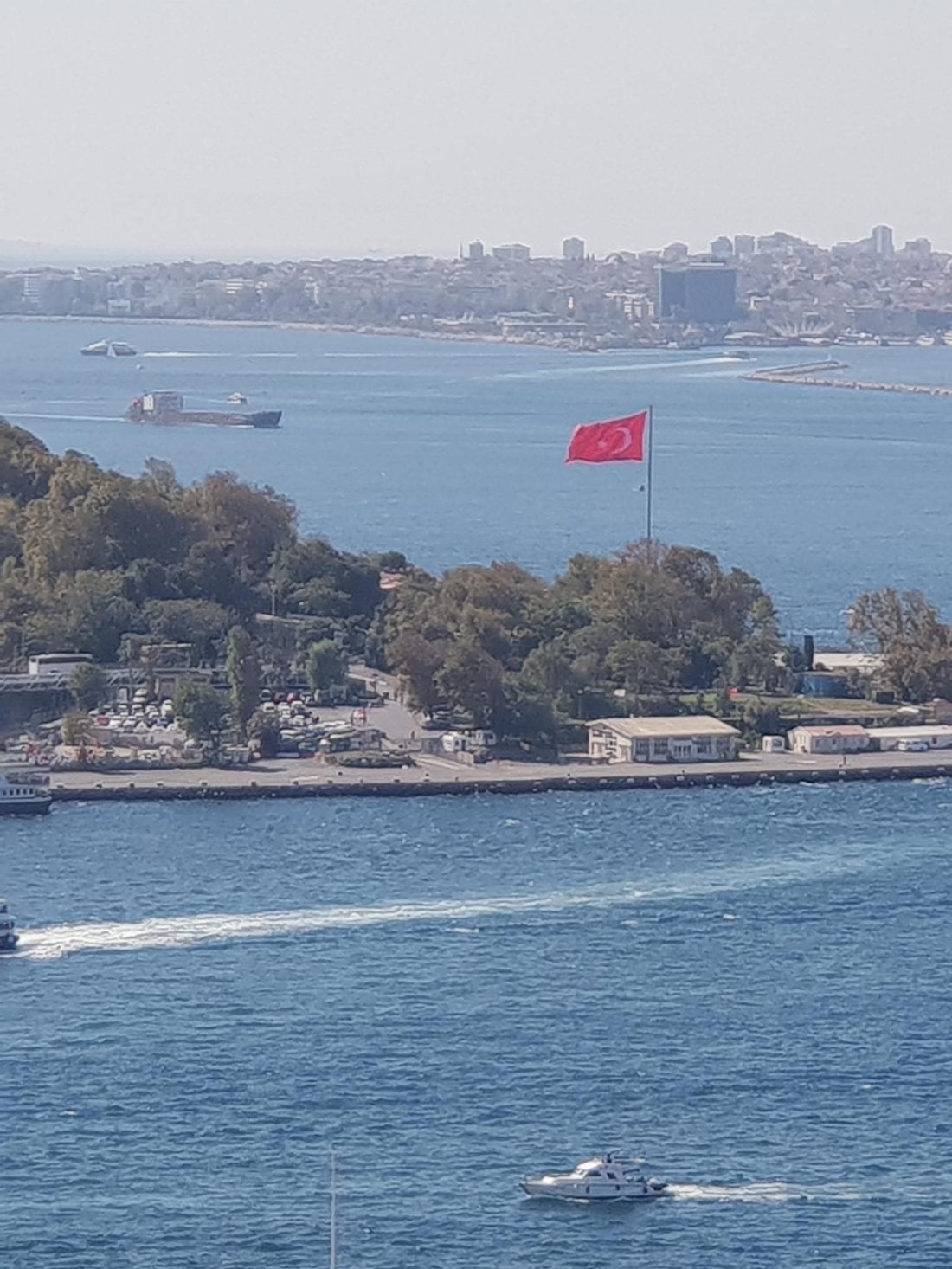
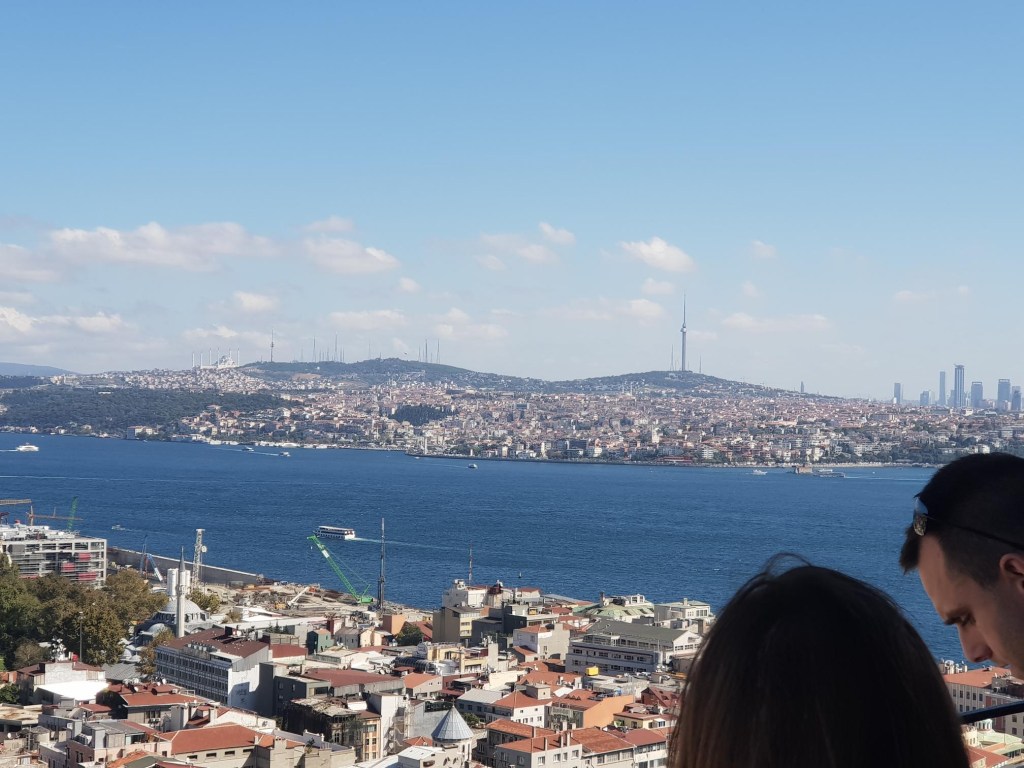
The city of Istanbul city sits at the bed of the Bosphurus, with the river separating Istanbul across two continents, Europe and Asia. The only city in the world to be separated by two continents. A 20-minute boat trip from Eminonu Station takes you from Europe Istanbul to Asia Istanbul. A single fair will cost 7 liras which is close to 1 British pounds. The city is also known for the 7 hills which sits within the walls of the city, with each hill representing a famous mosque, university or other historical structure. Very similar to Rome.
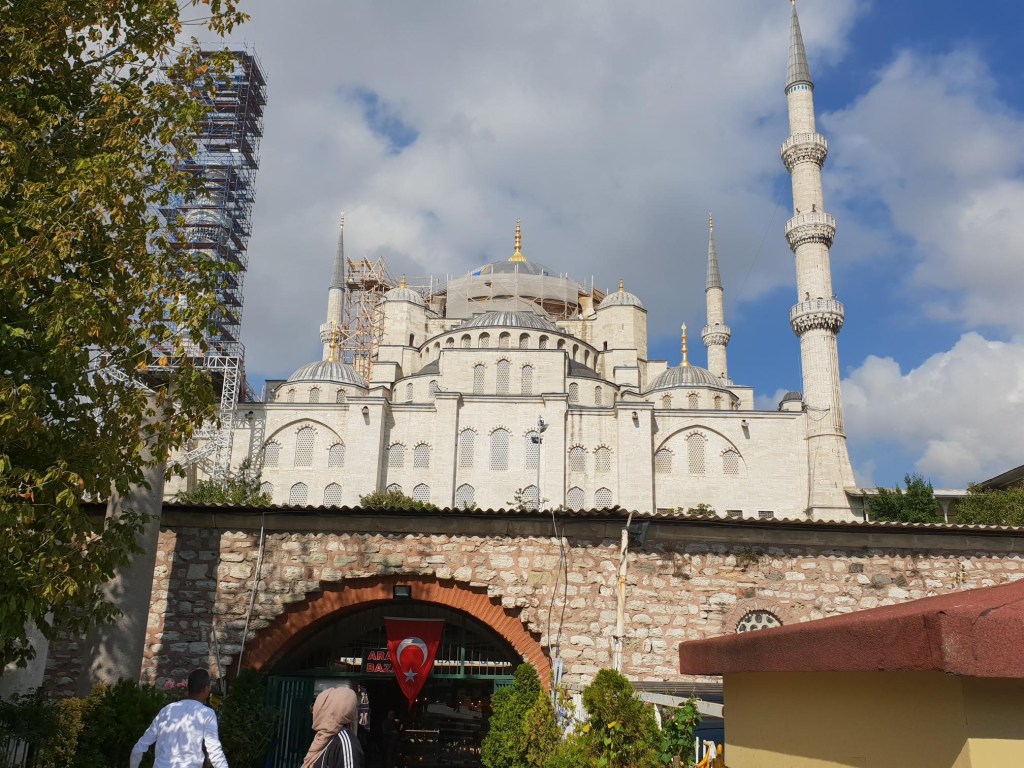
Sultan Ahmet Mosque: Referred to as the Blue mosque. Completed in 16th Century by Sultan Ahmet, the sultan ordered the making of the mosque to reassert Ottoman dominance across the city of Istanbul. The mosque imposes itself across the hills of Istanbul and is considered the most iconic sight of Turkey. The interior design is of carefully designed Islamic art across the ceiling and walls, the walls naturally light up giving it a blue effect. The mosque itself has 5 domes and 6 minarets which covers the outer structure of the mosque. The only other mosque with more minarets is the holy mosque in Makkah. Opposite the Sultan Ahmet sits the Hagia Sophia.
A view of the Blue Mosque from the Astara Bazaar entrance
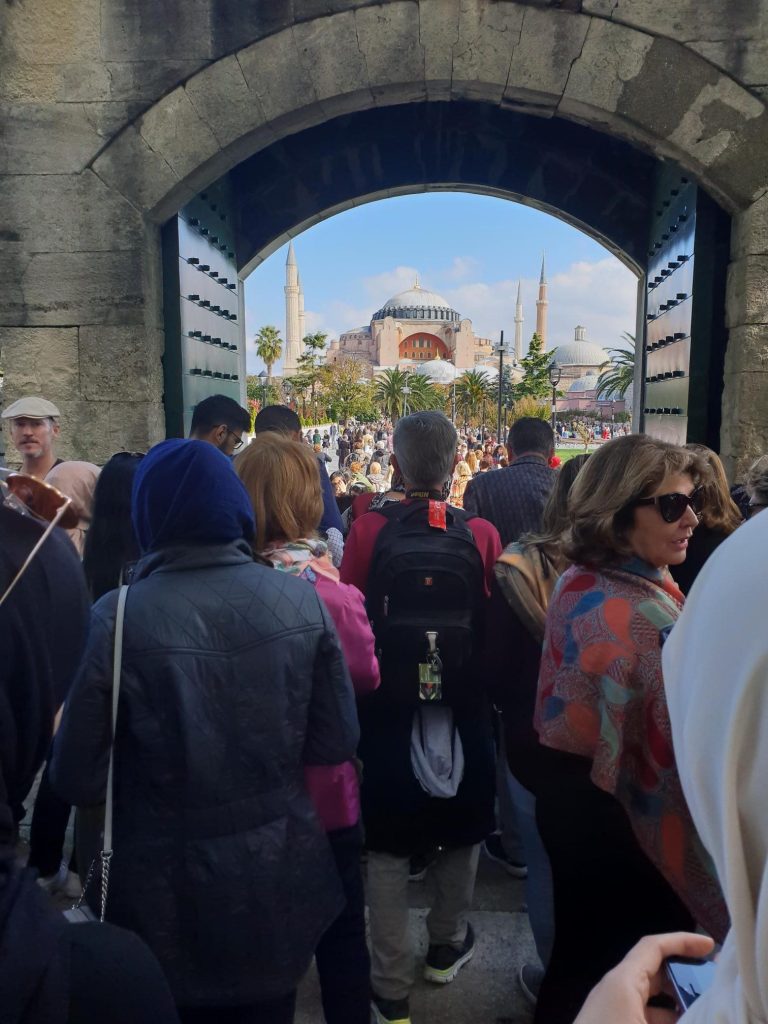
A view of the Haggia Sophiafrom the gates of the Blue Mosque
This may sound cliché; my hotel was situated within a two-minute walk from the blue mosque. Our route to the blue mosque involved us passing through Arasta Bazaar. The Arasta bazaar is a parade of 40 picturesque shops consisting of Turkish sweet shops, spice stores, traditional Turkish cafes, clothes and souvenirs shops. The Bazar itself was previously a horse stable for Ottoman Horses.
Hagia Sophia: Upon leaving the Sultan Ahmet Mosque a gate separates you from the court yard which leads to the Hagia Sophia (approximately a two-minute mosque). The residential court yard is used to soak-up some of the breath-taking views of the two mosques whilst also presenting you the opportunity to take some fantastic shots of both mosques. Istanbul is a city covered with mysticism but you can genuinely feel a positive energy between both mosques. Was it a hallucination or the placebo effect in full force?
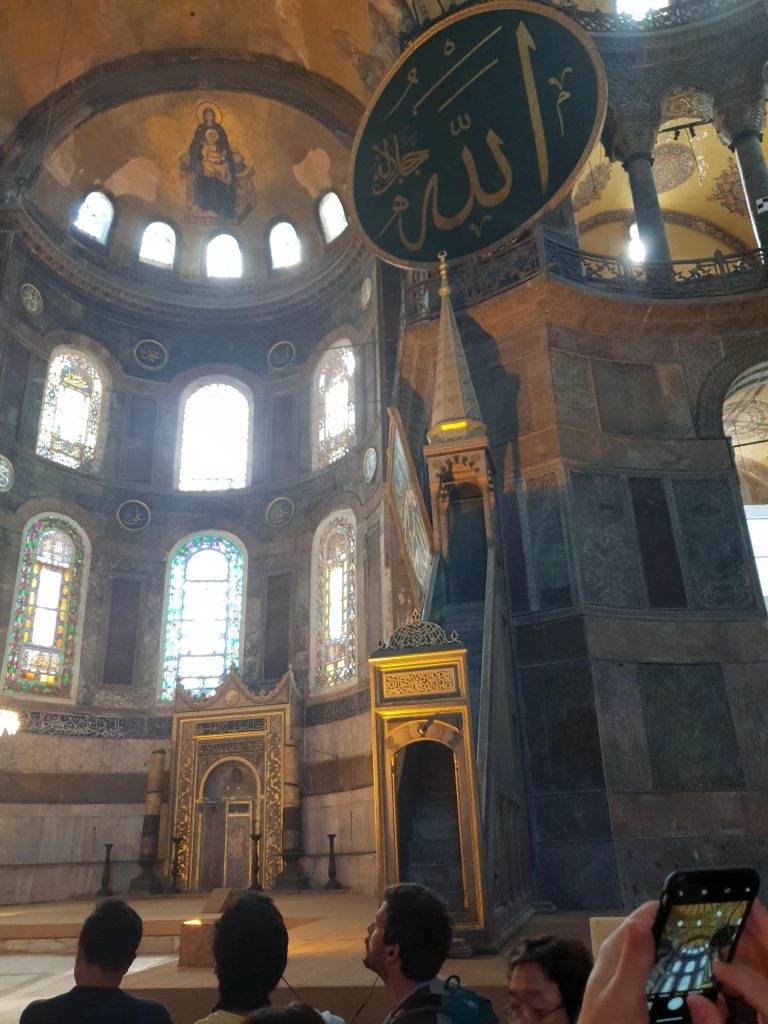
Top left of the domed ceiling of the Virgin Mary and a Circle Tablet of Allah (SWT) name, several other circled tablets can be found in the main hall Islamic art on the ceiling
With its four minarets and its huge dome that covers the circumference of the building. The Hagia Sophia demands it presence to its equal, Sultan Ahmet mosque. Much simpler in its design compared to Sultan Ahmet mosque; however, still an amazing sight.
Created in 300 BC, the Hagia Sophia was initially an Eastern-Orthodox church. However, centuries later, the Orthodox church converted to a Cathedral; several centuries later under the rule of the Ottoman’s, the Hagia Sophia was converted to a mosque.
Roof not a Dome? Up until the 16th century, the Hagia Sophia was a traditional medieval European church. However, the Ottomans converted the roof in to a dome and gave its own Ottoman identity.
Neither a mosque or church… The founder father of the Republic of Turkey, Mustafa Kemal Attarturk, ordered the Hagia Sophia to be preserved as a museum rather than a place of worship. Christianity, Islam or Secularism take your pick?
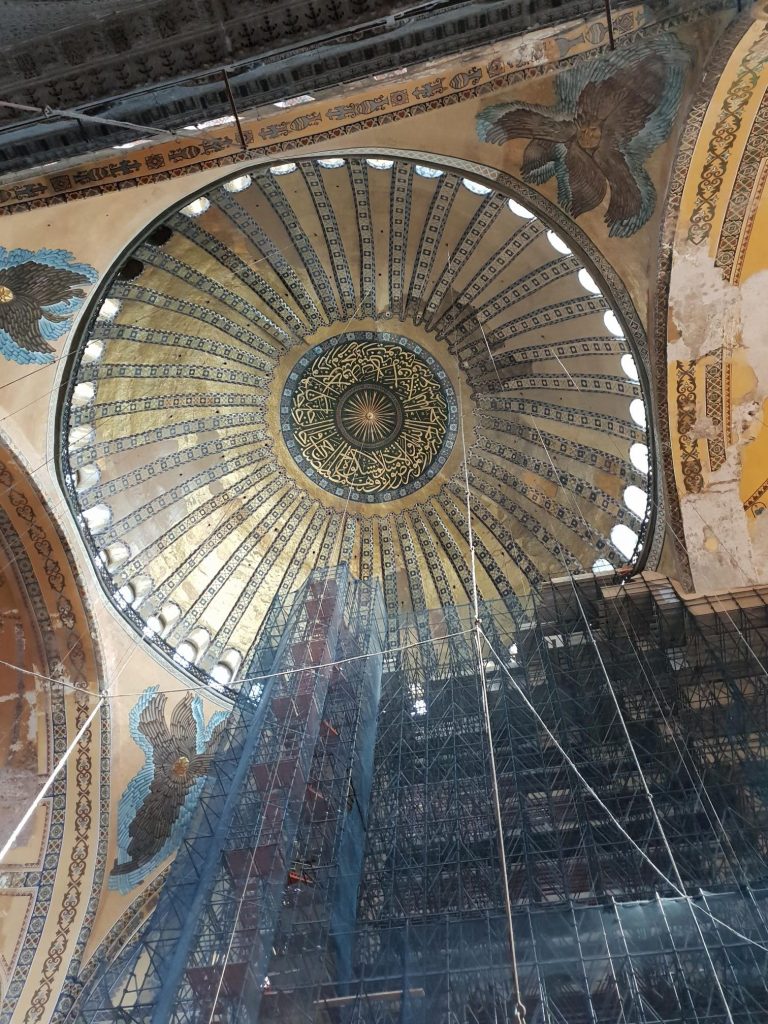
Once you enter the grand hall of the mosque, centuries of Christ-o-Islamic history can be felt in every slab, brick, art, colour and architecture which decorates the two-tiered gallery of worship. Several domes are embossed across the ceiling with fine Islamic art; at the foot of the dome, a perfectly drawn picture of the Virgin and Child is drawn. Other such pictures of baby Christ and the Virgin Mary can be found on the second floor. The corner of each pillar is covered by huge round tablets detailing the name of Allah(SWT), Muhammad (PBUH) and his Sahabas (apostles). The colours of all the ceilings were crowned in gold, giving it a strong sense of royalty across the mosque. One could imagine that the sultan and his closes advisors would have been regular visitors during their rule.
The walk way leading to the second floor takes you back a few centuries. Dark walk ways lit with the smallest flames and huge pebbled stones on all fours greeting you to the second floor. The second-tier gallery brings you closer to the art work so that you can really appreciate the artist craftsmanship. Views of the Blue Mosque can be seen through the mini-windows that are perfectly positioned opposite Sultan Ahmet mosque.
Top Kapi Palace Museum:
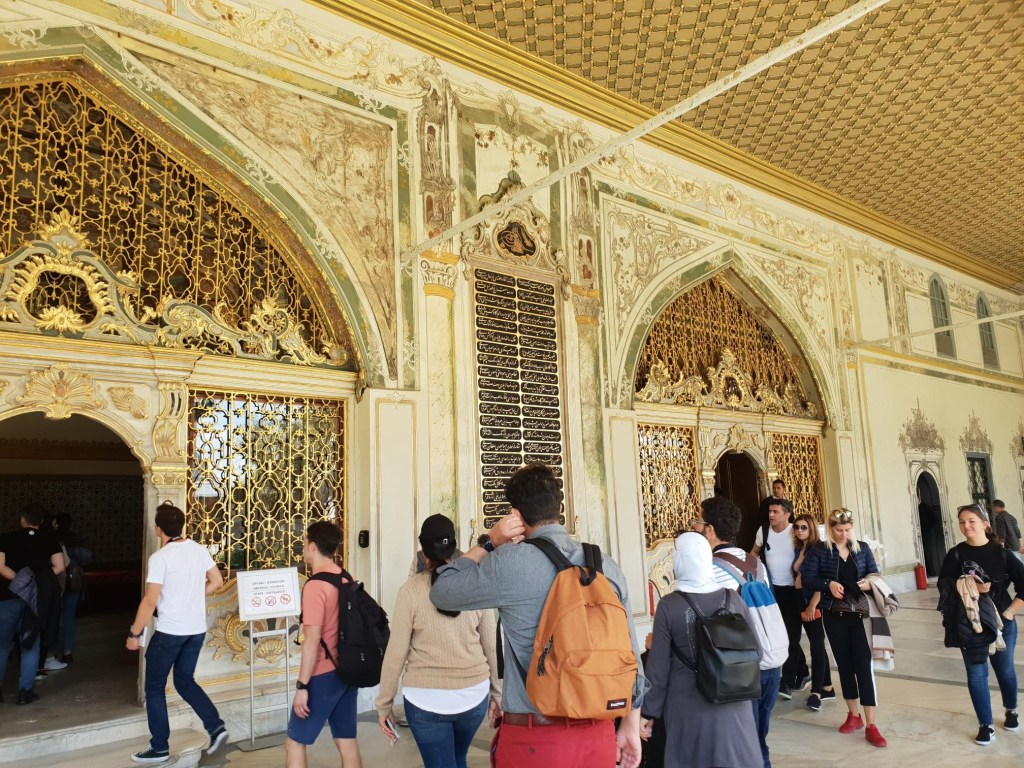
Top Kapi Castle was the home of the Sultan and head-quarters of the Ottoman government. A lot of the Ottoman Empire and it overseas territories would have been discussed within the confines of these walls. The Castle is beautifully designed from the palace quarters, gardens and court yards. A lot of detail has gone in to designing this grandeur palace. A grand gate guards you from the palace. Before the guarded gates were to detract intruders, now the guarded gates are used to stop people entering who don’t have tickets.
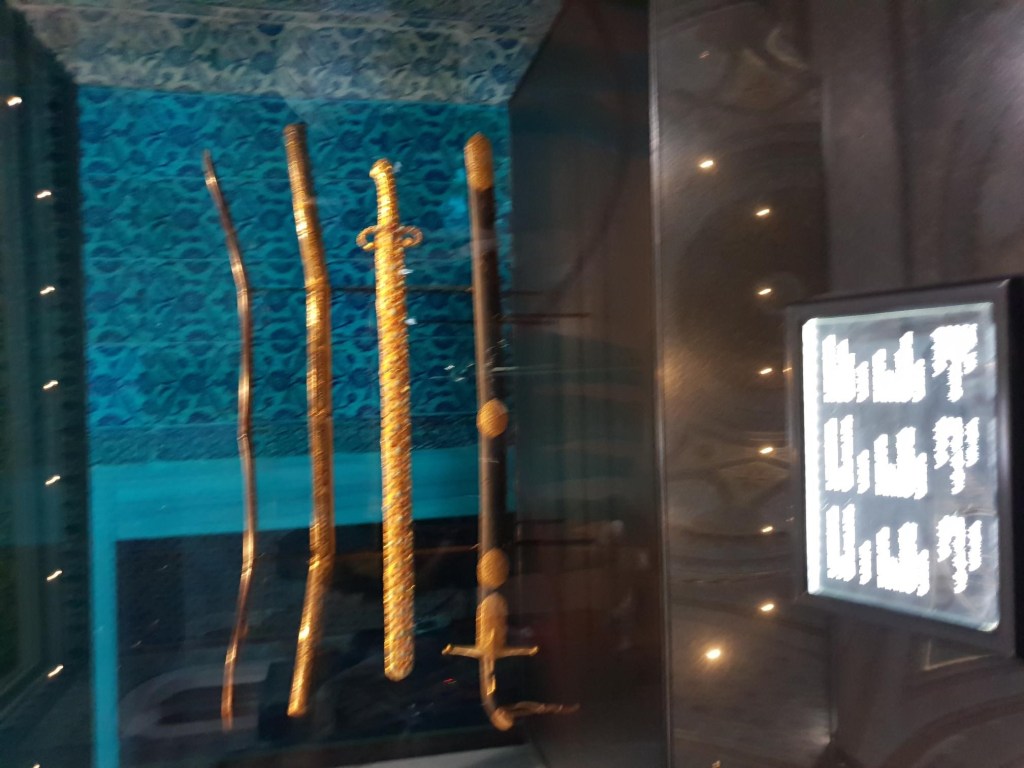
A lot of the palace displays where the Sultan and his governors would spend most of their days. There are also building displaying the history of the Ottomans; art, fine weaponry and Islamic relics.
There is a huge Sufi influence in Turkey and there is no exception to Istanbul. There is a demand for keeping relics. A lot of people buy in to some of the relics on display but I just couldn’t get my head around crying, seeing an alleged staff that belonged to the prophet Musa (PBUH), was it really his staff. Is the staff more important or his word?
The governors room where the Sultan’s advisor’s would have their meetings.
Grand Bazar
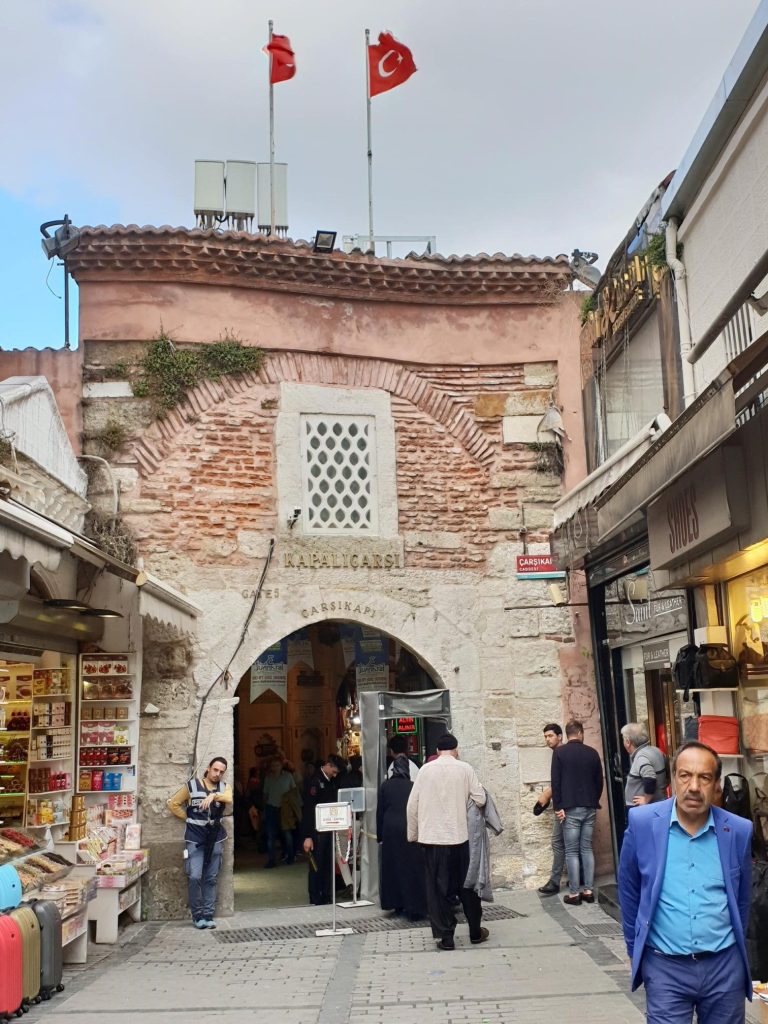
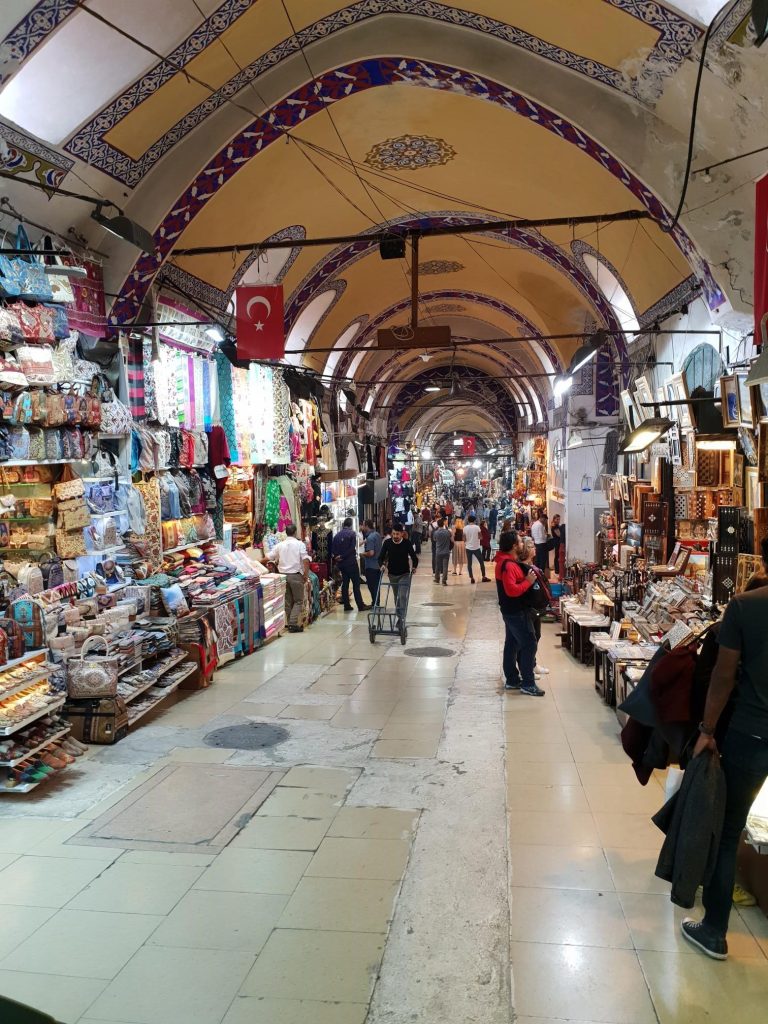
Two or Three tram stops from the Sultan Ahmet leads you to the Grand Bazaar. One of the largest and oldest opened markets in the world. The Grand Bazar has over 4000 shops covering across 61 streets. A lot of the architectural design has been preserved and it has the presence of a place which serves its place in history. Everything and anything can be brought in the Grand Bazaar. Rich in colour sulked up in every day Turkish trade, with over 500, 000 visitors a day, the overwhelming nature of the market can easily make you spend hours exploring.
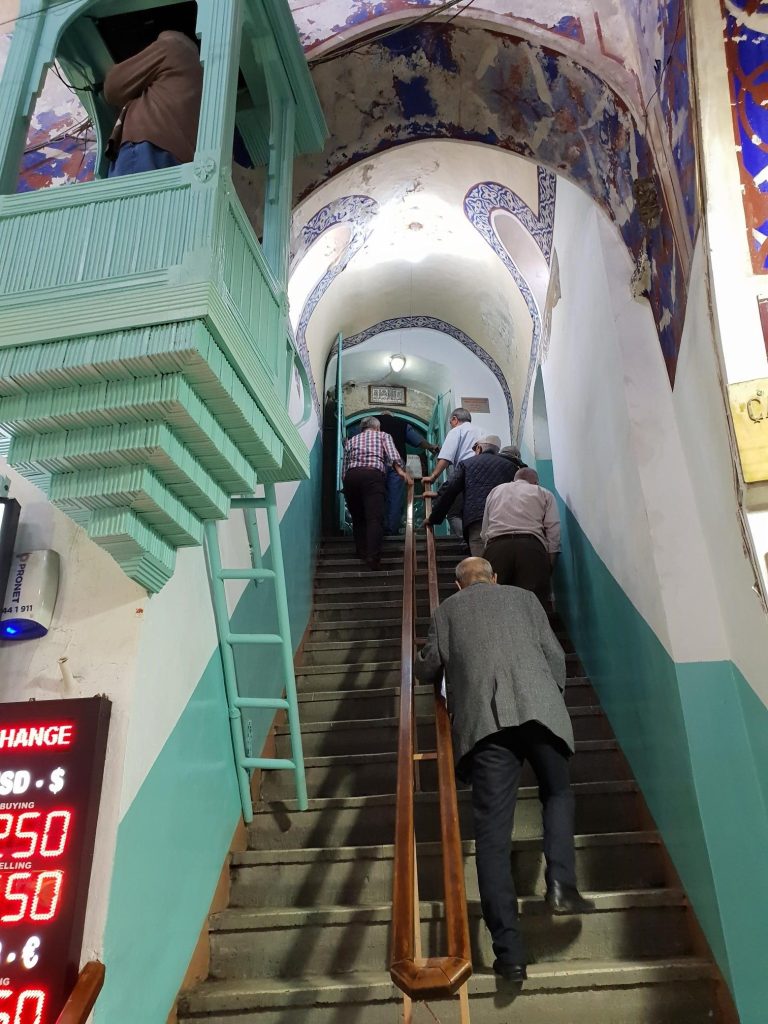
The Grand Bazar EntranceThe Prayer Hall stairs and the Ikama’s prayer pulpit
With loads of roads, rows and isles (little and small) within the market, it is very easy to get lost in the Bazaar. Once you are lost it can feel like a mirage, all the shops and isles can look the same, even the most vigilant have fallen victim to loosing themselves within the confines market.
*If you get a chance, try to visit the mosque within the bazaar, am sure there are more than a couple. One mosque I came across, had stairs leaning out in to the market, supporting a small hut with a mic. I saw a man skilfully making his way up the steps, he turned out to be the Muadhim (caller for prayer), he sounded out the Adhaan (call for prayer). There was another small unassuming stair’s next to the Muadhim’s stage, the narrow steps lead to a spacious two-tiered mosque.
One of the many row’s of the Grand Bazaar
Spice Bazar
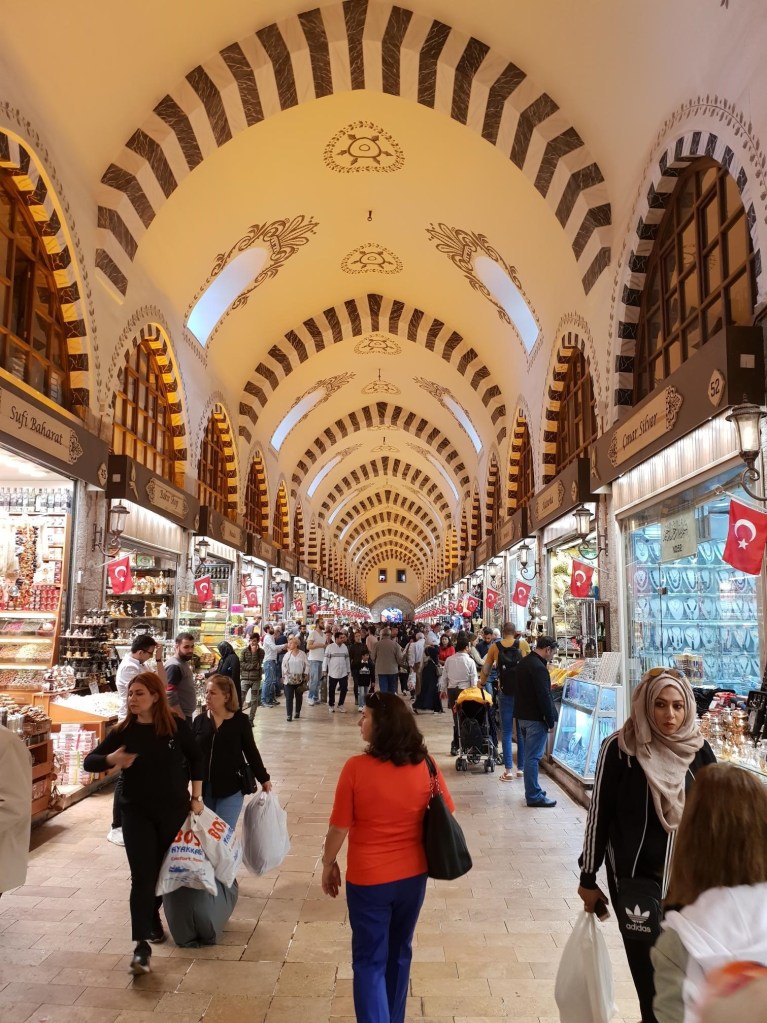
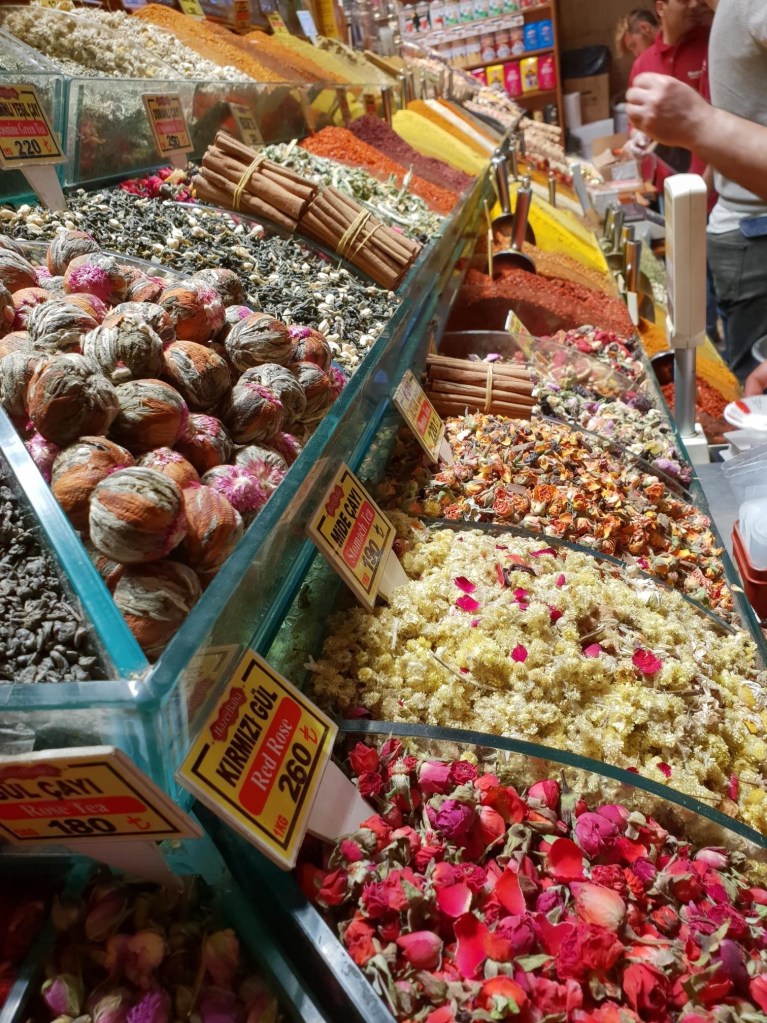
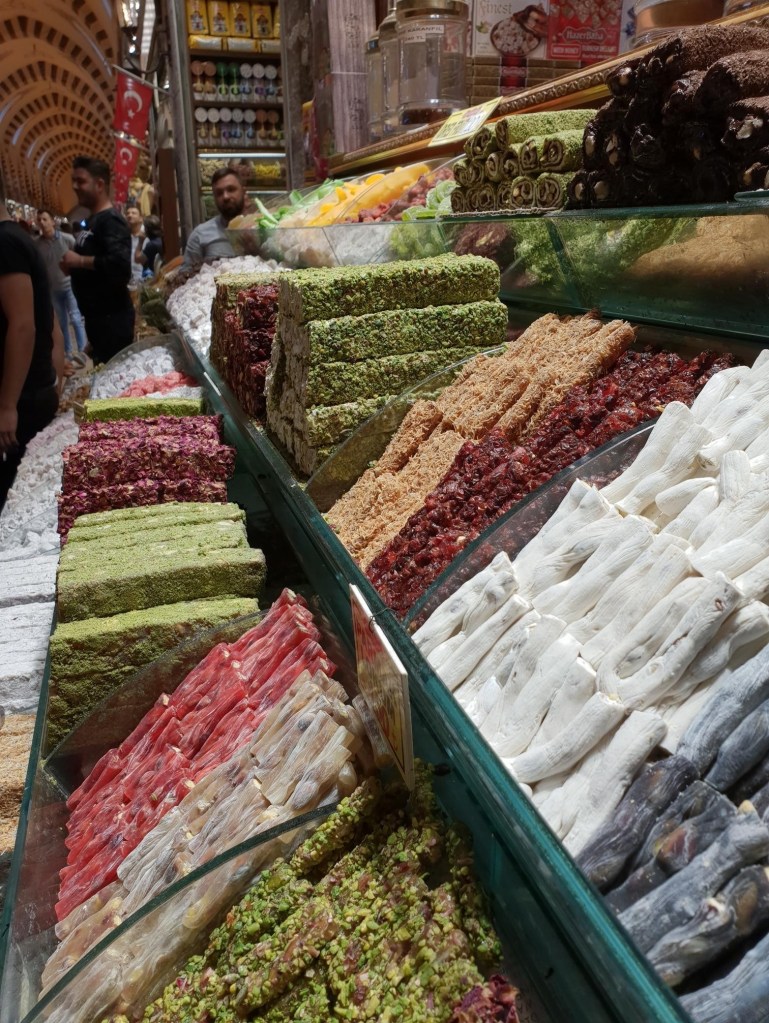
The Spice Bazar AKA the Egyptian market is adjacent to the Grand Bazaar. Not as big as the grand bazaar. However, the columns carefully shaped arches, each symmetrical to the other really spaces out the market. The coloured chandeliers along with the light, really gives the bazar a radiant feel. Each bazaar has its own character even though the same merchandise is being sold across all shops. Turkish Delight displayed across the back walls covering most colours of the colour spectrum. Whilst the front of the stores is covered by spices, pretty balls of Jasmine and dried coloured flowers. The distinct smell of the bazaar can effortlessly make you hallucinate whilst also making your wallet lighter.
The Egyptian BazaarHerbs and Spice on offer The Turkish Delight on display covering all colour spectrums
Golata Towers
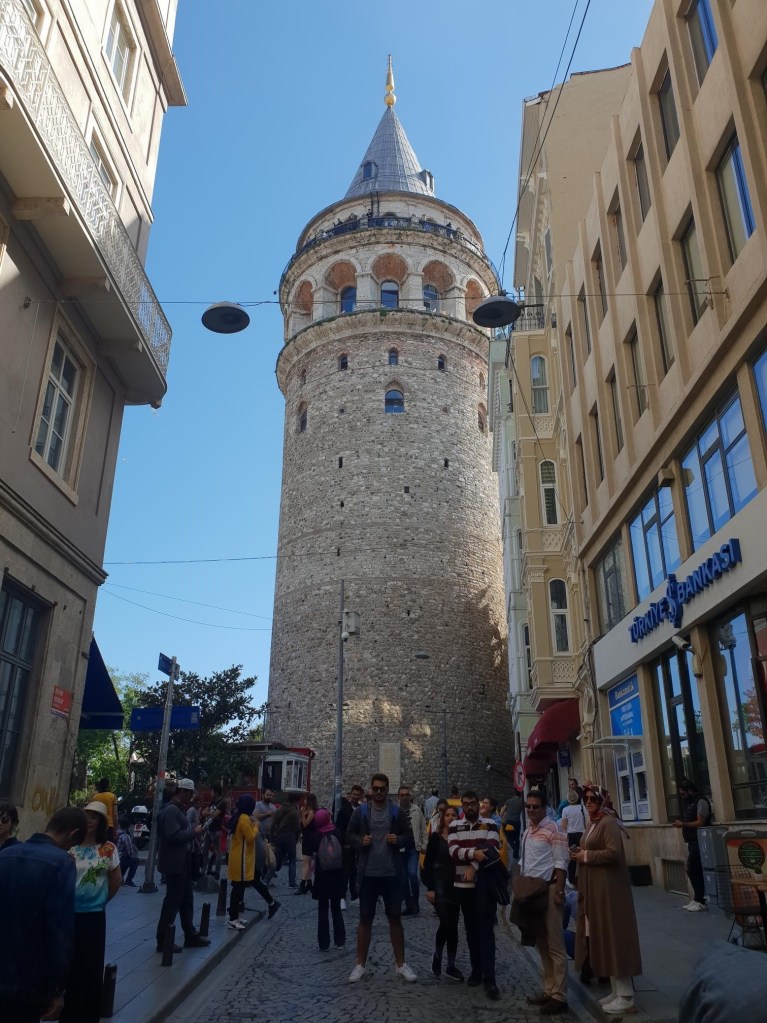
Golata Towers is practically a huge lighthouse currently aged 600-year-old. In all honesty, the brick work and roofing of the tower is spectacular. Sitting at a prominent hill top, Golata Tower imposes itself over the city, at the time it was the tallest structure in Istanbul. The purpose of the towers, was to safeguard the city of incoming threats through land and water. Most definitely worth a visit once you make it to the top. A fantastic panoramic view of the city with a restaurant inside so you can relax whilst taking in the view.
Front on view of the Golata TowersPanoramic View of the city on top of Golata Towers
Taksim Square
Taksim square is the equivalent to Bond Street. If your missing London and are fed up of eating the local food, Taksim Square is the place. A tourist hotspot, all the retail outlets are at your peril and so are all the food chains and fancy hotels. Like most other countries outside of London most recognisable brands are considerably cheaper. I never managed to visit Taksim Square during the night, however, I was told that there are some fantastic roof top restaurants to visit. The Old tram system still runs through the city. Very similar to vintage trams which run through Lisbon. I
Food:
Now there’s a mix response in respect to Turkish food. Some people absolutely love the food and others who did not like it at all. I personally think the food lacked flavour and spices. However, the fresh fish served up well, the prices were extremely fair in accordance to the portion size. I will be sticking to my local Turkish, Istanbul next to Tooting Bec. Fantastic food with great service. Deserves a visit
Meshur Eminonu Balik
Am assuming this must mean open boat fish restaurant. Well in any case, they serve a variety of fresh fish baps, which extremely tasty. I personally requested more onions and doused it with lemons. Worth a visit. Right next to Golata Bridge, not too far from Eminonu Station.
2.Golata Bridge Restaurants
Golata Bridge has several restaurants all which serve good fish dishes. In all honesty you have to be a terrible cook to mess up a fish dish. Nevertheless, all the restaurant on Golata bridge serve the same food. Different name, same food!!
People:
Like with major cities across the world. The people are hit and miss but it would be unfair to say that the people of Istanbul represent the whole of Turkey. Some people were extremely pleasant and others who were not as pleasant.
Sufism: Turkey is heavily influenced by Sufism; a lot art and design is Sufi inspired. Quite often tour guides will mention that the architecture of mosques and buildings, were artist and engineers inspired by Sufism. Most of the mosques are full of tombs of ‘saints’, Allah (SWT) knows best, avoid the grave worshipping as this is shirk.
Animal Friendly:
If you are an Ailurophile (cat lovers), then Istanbul is the city crying out for you. It is impossible to not spot cats in Istanbul. There are thousands walking, climbing, running and sleeping everywhere. Allhumdulilah all the cats were well fed and are extremely human friendly. The dogs are also equally treated to the same privilege.
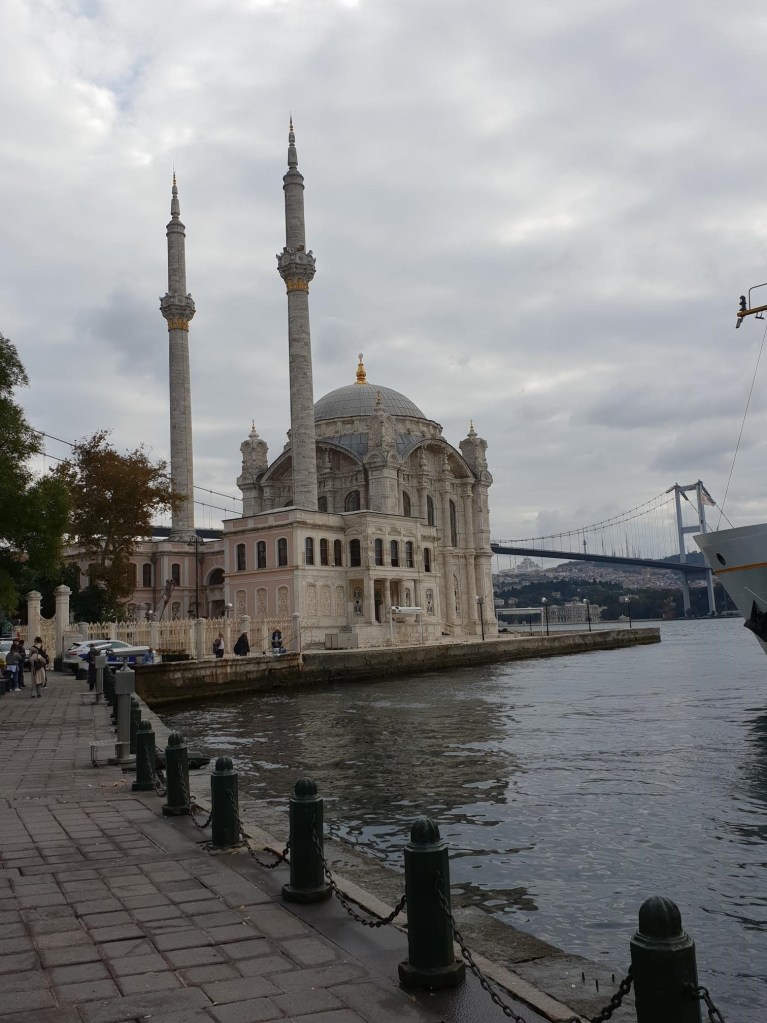
Other recommendations: Suleymeniye Mosque – Beautiful mosque with beautiful overseeing the Grand Bazaar and the Bosphorus River Boat tour. Rumeli Hisari Fort – First fort which was erected by the Ottomans. Ortakoy Mosque- A beautiful mosque on the banks of the Bosphurus. A cab journey is required.
Ortakoy Mosque on the Banks of Bosphorus river with the Bosphurus Bridges in the backgroud
Tips: Keep hold of a wireless mobile charger Walking Trainers as there is loads of walking involved Haggle especially with the cabs always bargain 10 liras less. Uber is no longer available




 El-Hajj Mohammed X- Hajj Blog