The Life and Times of Abu Bakr (r.a)

This will be a four-part series covering the lives of the four the most influential Muslim’s after Muhammad (PBUH), these four men were the closest of the Sahaba’s (companion’s) to our beloved prophet. The prophet (pbuh) spoke highly of these great men and went on to confirm that they would be amongst ten to be granted Jannah. Abu Bakr (r.a), Umar ibn Khattab (r.a), Ali Ibn Talib (r.a) and Uthman (r.a) went on to play crucial as Caliph’s after the prophet’s death; the four caliphs are referred to as the four rightly guided Caliphs. I will explore their lives in these blogs Inshallah.

*The blogs are a brief reflection of the sahaba’s life. I do strongly recommend picking up biographies in Islamic shops or attending Sira studies in mosque’s and Islamic colleges.
The early years:

Born in Mecca, Abdulla Ibn Quhafah, better known as Abu-Bakr Siddique, was the son of Uthman Abu Quhafa and Salma Umm Al-Khair. Abu Bakr (r.a) was born into the Banu Taym tribe of Quraish. Due to the harsh conditions in Makkah, the babies of Quraysh were sent to live with Bedouins in the desert, Abu Bakr (r.a) also spent his infancy in the desert. Due to his love for Camel in the desert, he was later given the title the ‘father of camels’ or better known as Abu Bakr. For the benefit of this blog and owing to the popularity of his nickname, we will refer to him as Abu Bakr (r.a).

Unfortunately, not much is not known of his early life. However, like with any of the rich children of Quraysh, he was literate and had a love for poems. At an early age he managed to gain the respect of his tribe due to his impeccable manners. He was very polite and well spoken and this helped him in his later life.

His physical Features

According to all accounts he was tall, thin but with big sized legs; he was also of fair complexion. Due to his thin frame his clothes had to be constantly adjusted as they would not sit on him. His eyes were sunken, and he also had a protruded forehead. In his older years he had white hair and dyed his hair with henna.

His interest and career:                                             

From a young age Abu Bakr (r.a) had an interest in poetry and genealogy of the Quraysh and the politics of all his ancestors. He was also known for his very good memory. Abu Bakr (r.a) at the age of 18 became a cloth merchant which was his family business. A young Abu Bakr (r.a) flourished financially as a cloth merchant. Makkah was an important trading hub of Najd (Present Saudia Arabia) due to it’s caravan route for traders coming from Abyssinia, Yemen, Iraq and Syria. Abu Bakr (r.a) would also venture out to the aforementioned countries to sell his trade. Unlike other merchant’s he did not require to sell dishonestly or slander other merchants; rather his willingness, hard work, hospitality, good manners, well spoken etiquettes attributed to his success.

Through his travels he gained a better perspective of life which made him stand out from the rest of his tribe. His travels brought him more financial success and made him amongst the richest of Quraysh, and his impeccable manners along with strong social networks across Makkah lead to Abu Bak (r.a) being the chief of the Banu Taym tribe.

Abu Bakr (r.a) accepts Islam:

If there was anyone that was going to accept Islam first it would have been Abu Bakr (r.a). He was a well-versed individual who was well balanced in all aspects of his life. A huge sign of his logical reasoning was demonstrated at an early age, a story reminiscent to that of Sayidinna Ibrahim (pbuh). When he was a child, his father instructed him to pray to the idol gods. A young Abu Bakr requested for these idols to provide him with food, clothes and money, each time the idols were despondent. He then threw a stone at the idol gods, to which the gods were unable to protect themselves from. After that incident, Abu Bakr never prayed towards the idols. Also, on his travels to the different part of the Shaam, he would have met with Jews and Christians, and the previous stories and messages would have made sense to him, so it would have been easier for him to accept Muhammad (pbuh) message.

Despite being from a rich family and the cultural norms of the Meccan’s at the time. Abu Bakr never drank wine, committed adultery, gambled, or engaged in any of the immoral activities that many of the Quraysh were involved in. Contrary to the above, when asked about his days of pre-ignorance, he explained that he refused to involve himself in any of the above for the sake of preserving his character.

Upon arriving from a business trip from Yemen, Abu Bakr (r.a) was informed, that Muhammad (pbuh) declared himself a messenger of Allah and he then accepted Islam as his religion. This decision would not have been difficult as Muhammad was loved and respected amongst the Quraysh. Muhammad was known for his honesty and upright character.  Abu Bakr was amongst the first free men to accept Islam.

Abu Bakr (r.a) early struggles and influences

Unfortunately, Muhammad (PBUH) message did not sit well amongst the Quraysh. The Quraysh were in opposition to Muhammad’s (PBUH) call to worshiping only Allah (SWT). Whilst they believed in Allah (SWT), they also believed in other idol gods, like Al-Lat and Al-Uzza, as equal gods to Allah (swt). Muhammad (PBUH) and his early followers were heavily persecuted for their beliefs.

Abu Bakr was once beaten by members of Quraysh, quite brutally in once instance, where he was knocked unconscious; however, this never stopped him from believing in Allah (SWT) and his messenger. Abu Bakr (r.a) played a huge role in bringing Uthman Ibn Affan (r.a), Abdur Rahman Ibn Awf (r.a), Saad Ibn Waqqas (r.a), Al Zubayr (r.a) etc… to the fold of Islam. The named Sahabas as we learn from history all played significant part in Islamic history. Abu Bakr also invested a lot of his own money in emancipating slaves. The most prominent of all the slaves that he freed was Bilal Ibn Rabah (r.a) who was severely tortured by his slave masters for accepting Islam.

Expedition to Medina

After several years of persecution and the added frustration of the growing number of conversions to Islam, the Quraysh had finalized a plan to kill the prophet of Islam. Knowing of their plans through the majesty Allah (swt), Muhammad (pbuh), informed Abu Bakr of their plans and they made plans to migrate to Medina. After successfully orchestrating the safe migration of Muslim’s to Medina, Abu Bakr (r.a) accompanied the prophet to Medina.

That night Muhammad (pbuh) also requested that Ali (r.a) sleep in his bed as the Quraysh were looking to ambush him in his house. The Quraysh were in shock to learn that Ali (r.a) was in his bed which ultimately foiled their plans. This gave Muhammad (pbuh) and Abu Bakr (ra) precious time to venture towards Medina. The Quraysh were livid and were hot on their heels in search og the messenger or Allah and his most trusted companion. At one stage the Quraysh were in touching distance of Muhammad (pbuh) and Abu Bakr (r.a); Abu Bakr was filled with fear for the prophet’s life. The prophet responded “Be not sad (or afraid), surely, Allah is with us. Abu Bakr (r.a) and the prophet were protected from the Quraysh. After this incident they both safely made their way to Medina.

Battles that Abu Bakr (r.a) participated in;

Abu Bakr (r.a) participated in several battles alongside the prophet; Battle of Badr, Battle of Uhud, Battle of the Trenches, Battle of Hunnayn and the Battle of Khaybar. In those battle’s, Abu Bakr played a crucial role, never did he waiver in his belief and neither was his bravery compromised. On several occasions he defended the prophet (pbuh) and commandeered different branches of the army in these military campaigns.

To provide an insight of Abu Bakr’s (r.a) bravery and firm conviction in Allah (swt) and his messenger, you would have to examine what limits he would have gone to defend his religion. Abdur Rahman Ibn Abu-Bakr, son of Abu Bakr (r.a), fought against his father during the battle of Badr. Abdur-Raman disclosed to his father that he was in striking distance of his father, but he did not have the heart to kill him. Abu Bakr’s (r.a) responded, that if the opportunity had arisen, he would not have hesitated to kill his son, and that, demonstrates Abu Bakr’s (r.a) conviction in Islam.

The Prophet’s death and being elected the first caliph!!!!

After the successful conquest of Mecca, the prophet (pbuh) completed his farewell pilgrimage and gave his final sermon, for he knew that this would be his final year on this earth. A couple of months later he fell ill and became very weak, so weak that he was unable lead salah in the mosque. On his first day of severe illness, the sahabas waited patiently for the prophet to lead salah, and at the point, the prophet instructed Abu Bakr should lead Salah in his absence, which he did. The Fajr salah before the prophet died, got out of his bed and looked out of the window and greeted his brother with a smile, Abu Bakr decided to move himself from the position of Imam, but the prophet insisted that Abu Bakr maintain his position, he retired back to his bed. Not too long into the day he passed away in Aisha’s house, his wife.

After the prophet’s death, Medina became chaotic and people almost fell into disbelief. People were distraught knowing that the prophet died, so much so, Umar (r.a) threatened to behead any muslim who declared the prophet’s death, at that point Abu Bakr (r.a) addressed the people with a firm voice reminding them that the prophet had indeed died just like other prophet’s,  but indeed he who worship’s Allah knows that he is ever living and never dies. Abu Bakr (r.a) managed to control a situation which could have possibly led to chaos and disbelief.

It is important to note that Abu Bakr (r.a) was known to be an emotional person who often cried. However, during a difficult time, he managed to control his emotions and made critical decision which prevented fitnah. 

News broke out that members of the Ansar were going to appoint a caliph (Islamic leader) amongst themselves and their aim was to exclude the Muhajiroun’s from their appointment.  Umar (r.a) and Abu Bakr (r.a) quickly went to stop the appointment of a caliph. A dispute had broken between the Ansar and the Muhajiroun, the Muhajiroun claimed that the leader would have to be someone from amongst the Quraysh. The Ansar had proposed joint leadership of caliph leadership from both the Ansar and the Quraysh, this proposal was strongly rejected by the Muhajiroun. Umar (r.a) responded that this would cause disunity amongst the muslim’s. At that point Umar (r.a) reminded those in attendance that it was Abu Bakr (r.a) who accompanied the prophet during his escape from Makkah and that it was also Abu Bakr who was appointed to lead the Hajj to Makkah in his absence. Umar (r.a) then pledged allegiance to Abu Bakr (r.a) followed by the Muhajiroun and the Ansar. It is important to note that both Uthman (r.a) and Ali (r.a) also pledged allegiance to Abu Bakr (r.a).

Contrary to distorted views, Ali (r.a) was in support of Abu Bakr’s leadership. The reason for his absence was due to the grieving the prophet’s death. When he heard of the growing tension of this particular meeting he quickly dressed and pledged his allegiance to Abu Bakr (r.a).

It was also reported that the prophet (PBUH) had disclosed that once he was asleep, he was standing over a well with a bucket; he saw Abu Bakr (r.a) drawing water from a well, after two attempts of pulling water out of the well, Umar Ibn Khattab (r.a) had continued drawing water out of the well. This was a strong indication that Abu Bakr (r.a) was strongly positioned to be a caliph first.

Ridah Wars and crucial decisions!!!

Before the prophet (pbuh) passed away, he ordered an army of 3000 men led by a youthful Usama Ibn Zaid to battle the Byzantine’s. However, this campaign was put on halt as the prophet (pbuh) had passed away. With the chaos that ensued after the prophet’s (pbuh) death many people were leaning towards apostacy and there was a need to have a leader appointed to steer the Muslims.

After learning of the apostacy across the Najd (arab peninsula), many sahabas believed that Abu Bakr (r.a) should focus on dealing with the apostacy rather than continuing with the Byzantine campaign. Under a lot of pressure, Abu Bakr (r.a) stood firm with his decision that the battle of Mutah should be fought as per the prophet’s wish.

After the successful campaign of Mutah. Abu Bakr (r.a) spent the remainder of his leadership battling apostates and other Arab tribes that posed a threat in the Najd. After successfully defeating the Byzantine’s at the battle of Mutah, some sahabas were keen to engage with other empires to spread Islam; however, Abu Bakr (r.a) did not become overzealous with the idea of engaging with other empires, rather he wanted to unite the arab’s under one faith.

Abu Bakr (r.a) successfully completed many campaigns across the Najd, the most notable campaigns were against Musailamah Al-Khazab (Musailamah the Liar), Tulayha and Al-aswad Al-Ans from Yemen, all false prophets.

The battle of Yamamah (battle against Musailamah) provided valuable lessons to Abu Bakr (r.a), unfortunately many of the sahabas that memorized the Quran were martyred in this campaign. At that particular time the Quran was yet to be completed. Umar (r.a) recommended that in order to compile the Quran, those who had memorized the Quran were not required to attend battles, as they would be required to support Zaid Ibn Thabit (r.a) in compiling the Quran.   

Both examples of the above demonstrate the excellent military tactics deployed by Abu Bakr (r.a) during a difficult time in Islamic history.  In a time of anarchy, disruption and chaos; Abu Bakr (r.a) was able to use sound mind to make tough decisions which were not always considered popular. By making these tough decisions, Abu Bakr (r.a) united the Arab peninsula under the banner of Islam, which then led to further successes across Persia and Syria.

Death

Abu Bakr’s (r.a) leadership lasted two years until his death. He was plagued a fever which he never recovered from that ultimately led to his death. He passed away in Aisha (r.a) house and was buried next to the prophet (pbuh). Umar-Ibn-Khattab (r.a) was chosen as his successor.
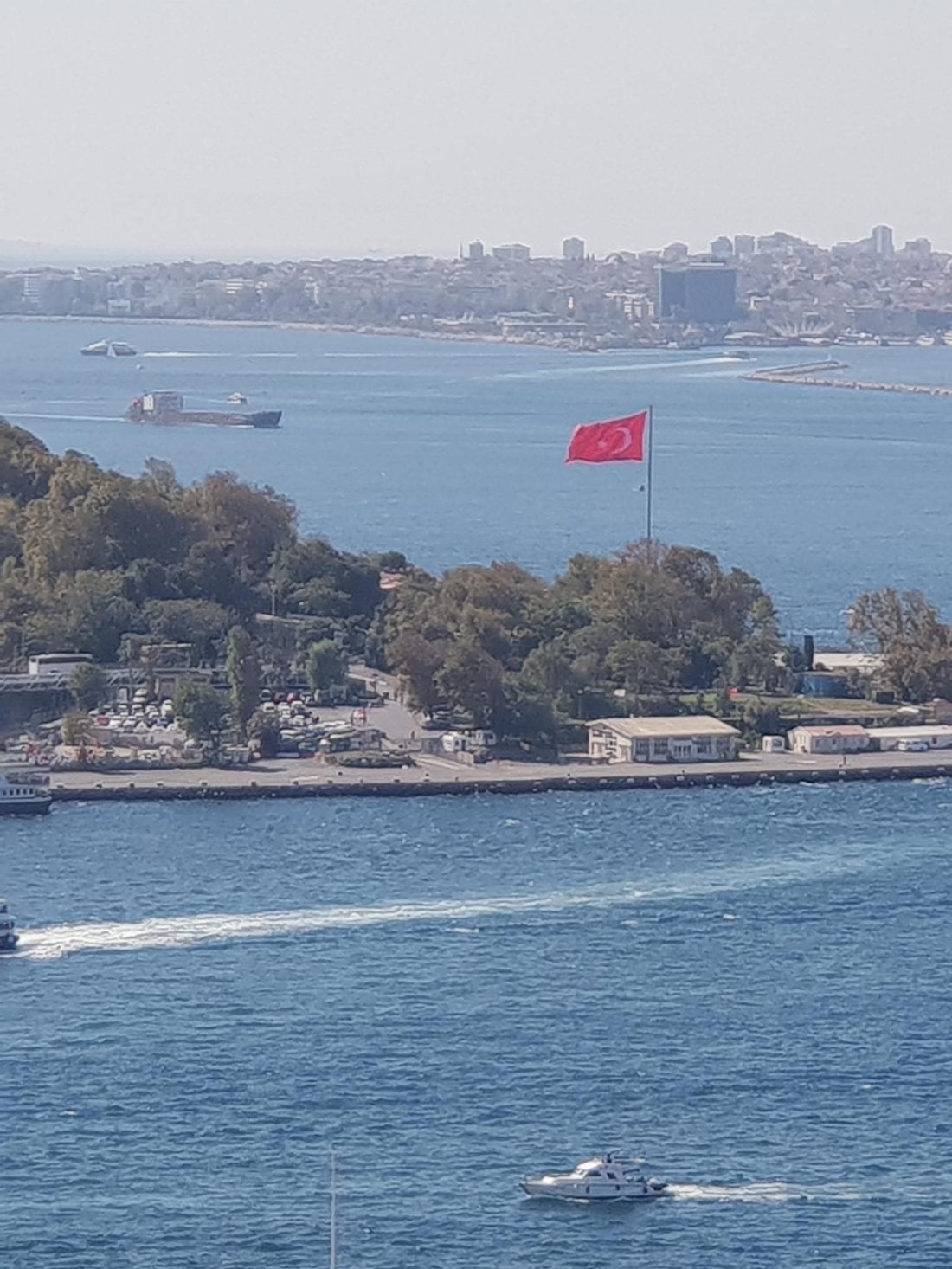
Istanbul – A 5 day journey across the fortress city.


Napoleon once famously stated ‘If the world was a single state, Istanbul would be the capital’. Napoleon’s praise for the city is a reflection of what millions think of this spectacular city today once they have made the visit.

Turkey is strategically based between three continents (Europe, Africa and Arabia & Asia), whilst also sharing the Mediterranean Sea, Aegean and Black sea. History teaches us that Istanbul has been a military and economical fortress for some of the mightiest empires in history. The Roman Empire, Byzantines and the Ottomans have used Istanbul as their hub and have profited hugely from this city in invading other territories. Whosoever, holds the key to the Bosphurus, owns the world. Constantinople (Istanbul) was the second capital of the mighty Roman Empire.

Each empire has left its mark on this great city. The Roman presence over the city is quite evident; the remnants of Roman cobbled roads, temples and churches can be found across city. However, the Ottoman influence in the past 500 years has left its own mark on the city.

The city of Istanbul city sits at the bed of the Bosphurus, with the river separating Istanbul across two continents, Europe and Asia. The only city in the world to be separated by two continents. A 20-minute boat trip from Eminonu Station takes you from Europe Istanbul to Asia Istanbul. A single fair will cost 7 liras which is close to 1 British pounds. The city is also known for the 7 hills which sits within the walls of the city, with each hill representing a famous mosque, university or other historical structure. Very similar to Rome.

Sultan Ahmet Mosque:
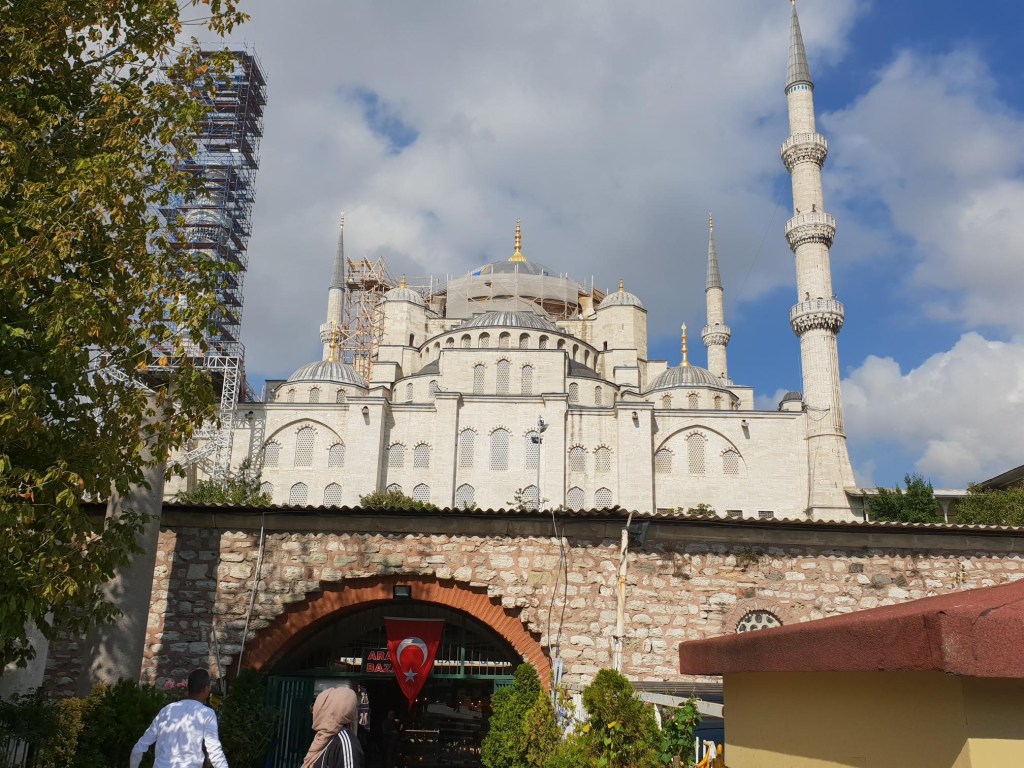
Referred to as the Blue mosque. Completed in 16th Century by Sultan Ahmet, the sultan ordered the making of the mosque to reassert Ottoman dominance across the city of Istanbul. The mosque imposes itself across the hills of Istanbul and is considered the most iconic sight of Turkey. The interior design  is of carefully designed Islamic art across the ceiling and walls, the walls naturally light up giving it a blue effect. The mosque itself has 5 domes and 6 minarets which covers the outer structure of the mosque. The only other mosque with more minarets is the holy mosque in Makkah. Opposite the Sultan Ahmet sits the Hagia Sophia.

A view of the Blue Mosque from the Astara Bazaar entrance
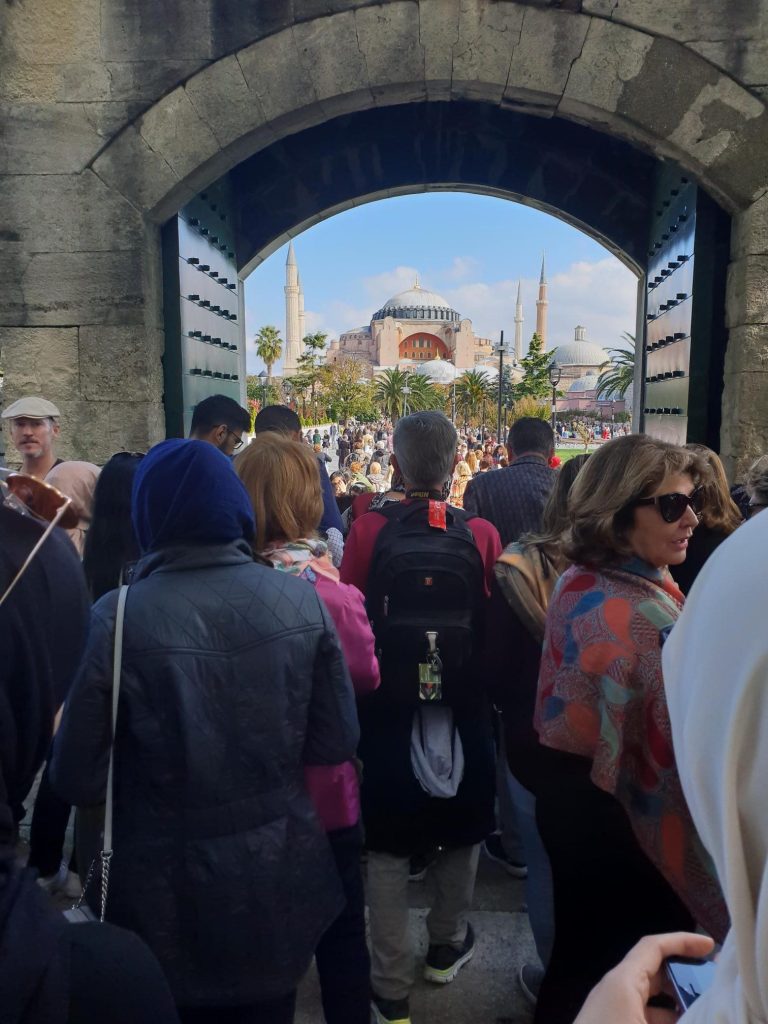
A view of the Haggia Sophiafrom the gates of the Blue Mosque

This may sound cliché; my hotel was situated within a two-minute walk from the blue mosque. Our route to the blue mosque involved us passing through Arasta Bazaar. The Arasta bazaar is a parade of 40 picturesque shops consisting of Turkish sweet shops, spice stores, traditional Turkish cafes, clothes and souvenirs shops. The Bazar itself was previously a horse stable for Ottoman Horses.

Hagia Sophia:
Upon leaving the Sultan Ahmet Mosque a gate separates you from the court yard which leads to the Hagia Sophia (approximately a two-minute mosque). The residential court yard is used to soak-up some of the breath-taking views of the two mosques whilst also presenting you the opportunity to take some fantastic shots of both mosques. Istanbul is a city covered with mysticism but you can genuinely feel a positive energy between both mosques. Was it a hallucination or the placebo effect in full force?

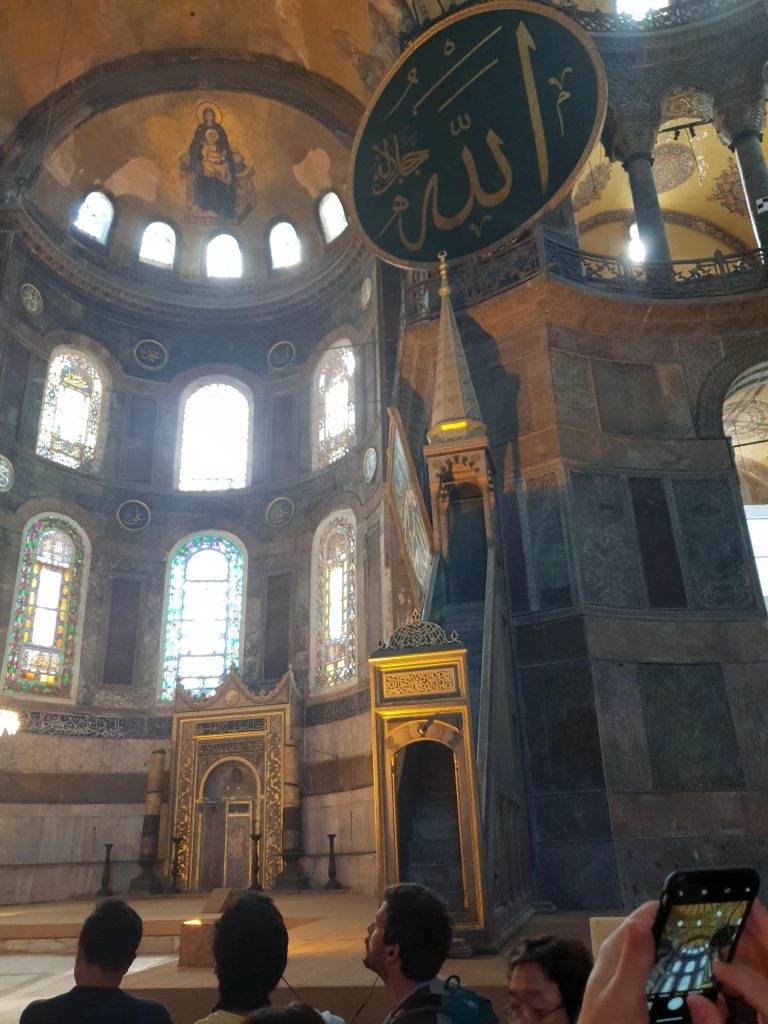
Top left of the domed ceiling of the Virgin Mary and a Circle Tablet of Allah (SWT) name, several other circled tablets can be found in the main hall 
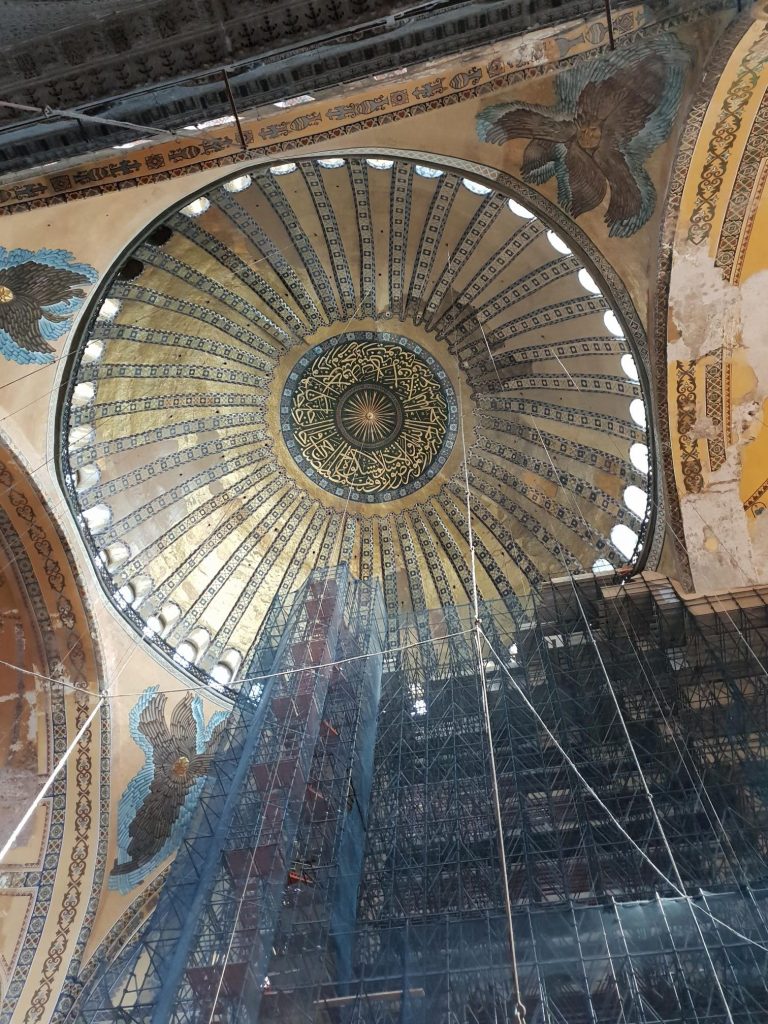
Islamic art on the ceiling

With its four minarets and its huge dome that covers the circumference of the building. The Hagia Sophia demands it presence to its equal, Sultan Ahmet mosque. Much simpler in its design compared to Sultan Ahmet mosque; however, still an amazing sight.

Created in 300 BC, the Hagia Sophia was initially an Eastern-Orthodox church. However, centuries later, the Orthodox church converted to a Cathedral; several centuries later under the rule of the Ottoman’s, the Hagia Sophia was converted to a mosque.

Roof not a Dome?
Up until the 16th century, the Hagia Sophia was a traditional medieval European church. However, the Ottomans converted the roof in to a dome and gave its own Ottoman identity.

Neither a mosque or church…
The founder father of the Republic of Turkey, Mustafa Kemal Attarturk, ordered the Hagia Sophia to be preserved as a museum rather than a place of worship. Christianity, Islam or Secularism take your pick?

Once you enter the grand hall of the mosque, centuries of Christ-o-Islamic history can be felt in every slab, brick, art, colour and architecture which decorates the two-tiered gallery of worship. Several domes are embossed across the ceiling with fine Islamic art; at the foot of the dome, a perfectly drawn picture of the Virgin and Child is drawn. Other such pictures of baby Christ and the Virgin Mary can be found on the second floor. The corner of each pillar is covered by huge round tablets detailing the name of Allah(SWT), Muhammad (PBUH) and his Sahabas (apostles). The colours of all the ceilings were crowned in gold, giving it a strong sense of royalty across the mosque. One could imagine that the sultan and his closes advisors would have been regular visitors during their rule.

The walk way leading to the second floor takes you back a few centuries. Dark walk ways lit with the smallest flames and huge pebbled stones on all fours greeting you to the second floor. The second-tier gallery brings you closer to the art work so that you can really appreciate the artist craftsmanship. Views of the Blue Mosque can be seen through the mini-windows that are perfectly positioned opposite Sultan Ahmet mosque.

Top Kapi Palace Museum:

Top Kapi Castle was the home of the Sultan and head-quarters of the Ottoman government. A lot of the Ottoman Empire and it overseas territories would have been discussed within the confines of these walls. The Castle is beautifully designed from the palace quarters, gardens and court yards. A lot of detail has gone in to designing this grandeur palace. A grand gate guards you from the palace. Before the guarded gates were to detract intruders, now the guarded gates are used to stop people entering who don’t have tickets.

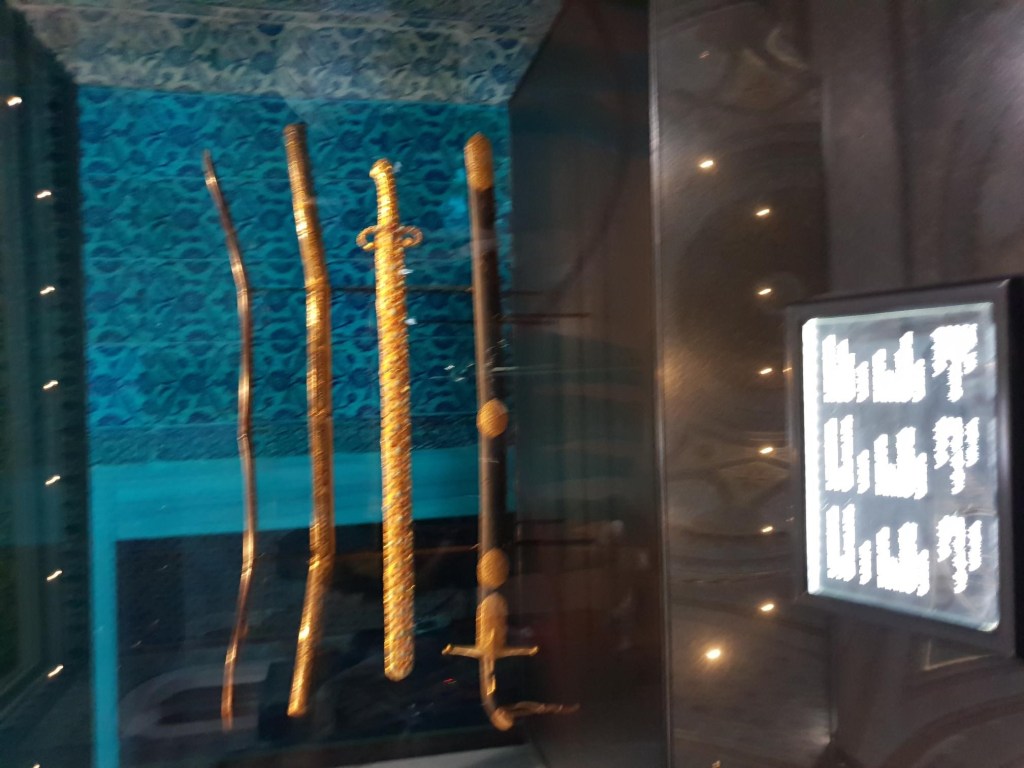
A lot of the palace displays where the Sultan and his governors would spend most of their days. There are also building displaying the history of the Ottomans; art, fine weaponry and Islamic relics.

There is a huge Sufi influence in Turkey and there is no exception to Istanbul. There is a demand for keeping relics. A lot of people buy in to some of the relics on display but I just couldn’t get my head around crying, seeing an alleged staff that belonged to the prophet Musa (PBUH), was it really his staff. Is the staff more important or his word?

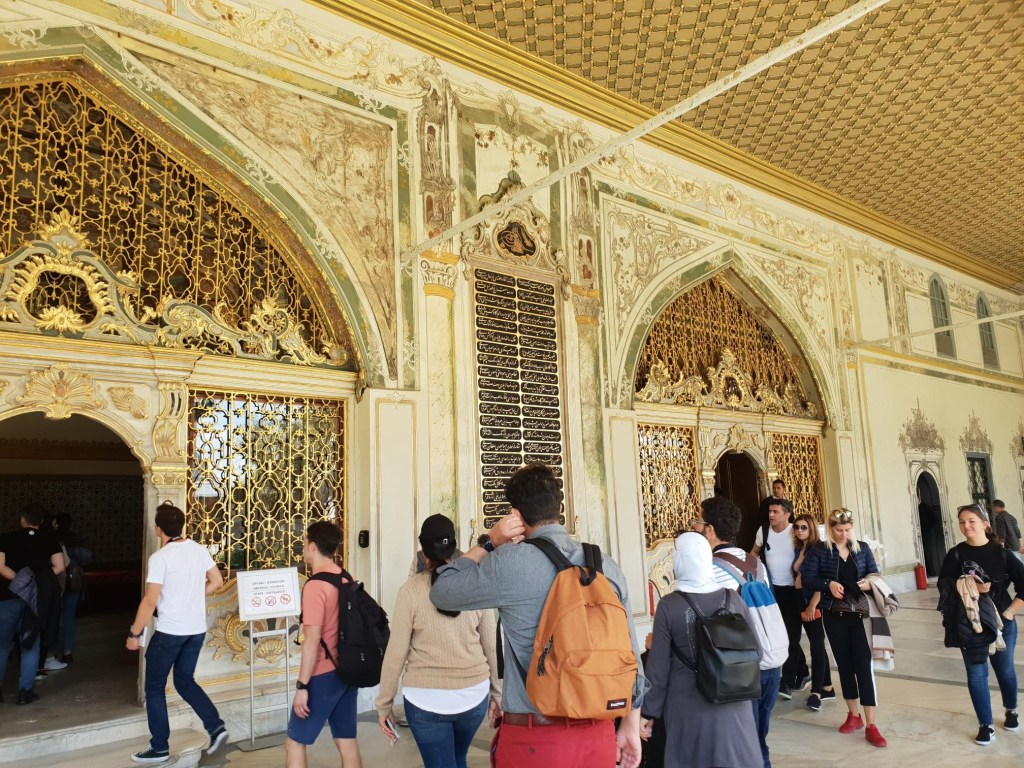
The governors room where the Sultan’s advisor’s would have their meetings.

Grand Bazar

Two or Three tram stops from the Sultan Ahmet leads you to the Grand Bazaar. One of the largest and oldest opened markets in the world. The Grand Bazar has over 4000 shops covering across 61 streets. A lot of the architectural design has been preserved and it has the presence of a place which serves its place in history. Everything and anything can be brought in the Grand Bazaar. Rich in colour sulked up in every day Turkish trade, with over 500, 000 visitors a day, the overwhelming nature of the market can easily make you spend hours exploring.

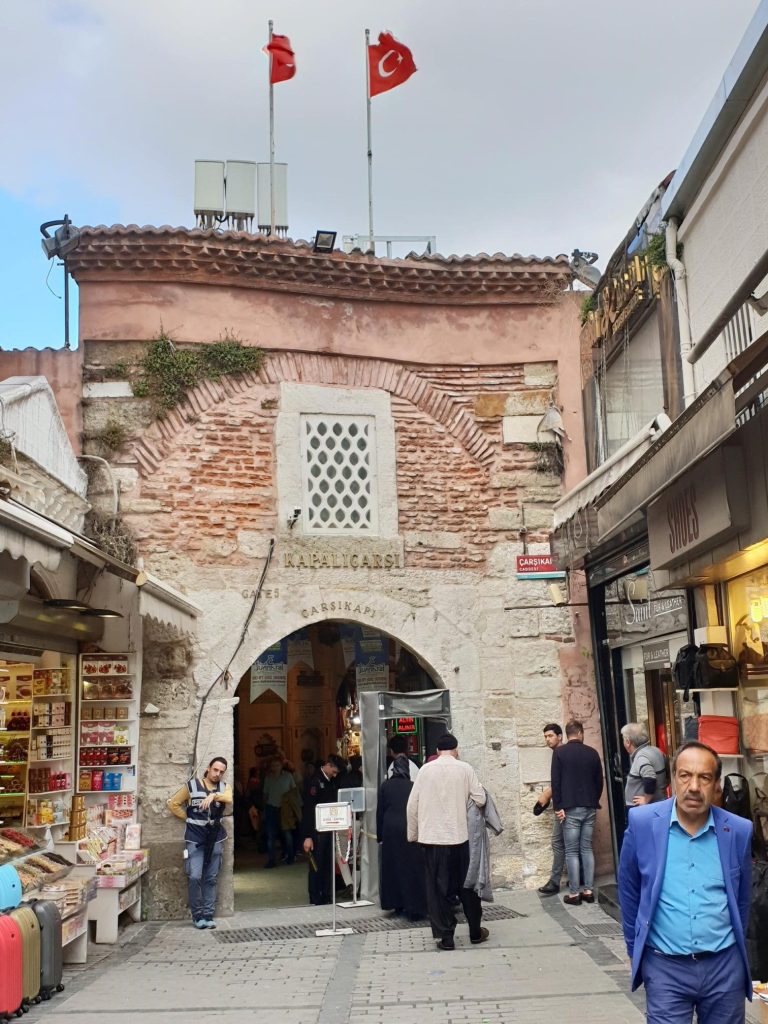
The Grand Bazar Entrance
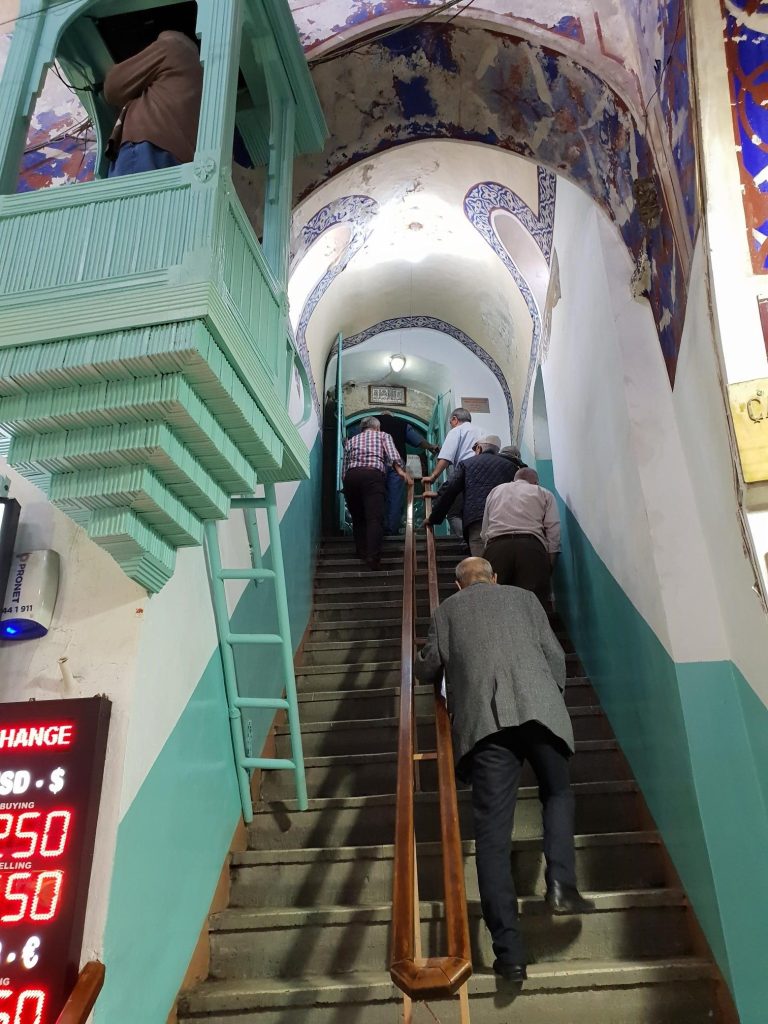
The Prayer Hall stairs and the Ikama’s prayer pulpit

With loads of roads, rows and isles (little and small) within the market, it is very easy to get lost in the Bazaar. Once you are lost it can feel like a mirage, all the shops and isles can look the same, even the most vigilant have fallen victim to loosing themselves within the confines market.

*If you get a chance, try to visit the mosque within the bazaar, am sure there are more than a couple. One mosque I came across, had stairs leaning out in to the market, supporting a small hut with a mic. I saw a man skilfully making his way up the steps, he turned out to be the Muadhim (caller for prayer), he sounded out the Adhaan (call for prayer). There was another small unassuming stair’s next to the Muadhim’s stage, the narrow steps lead to a spacious two-tiered mosque.

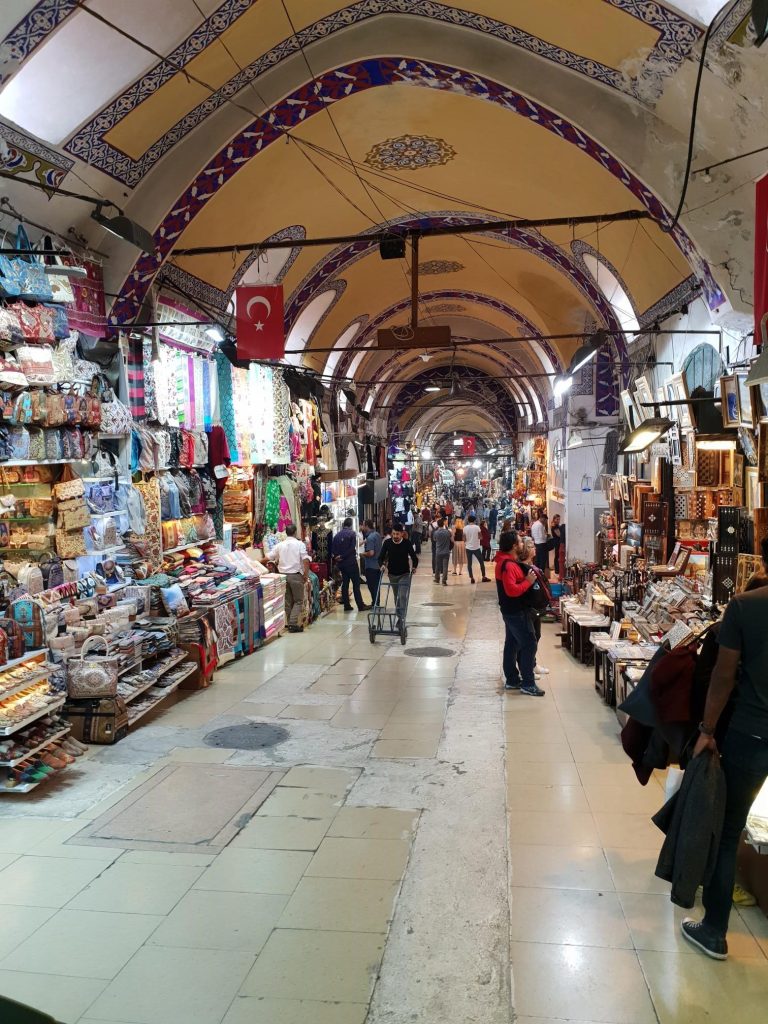
One of the many row’s of the Grand Bazaar

Spice Bazar

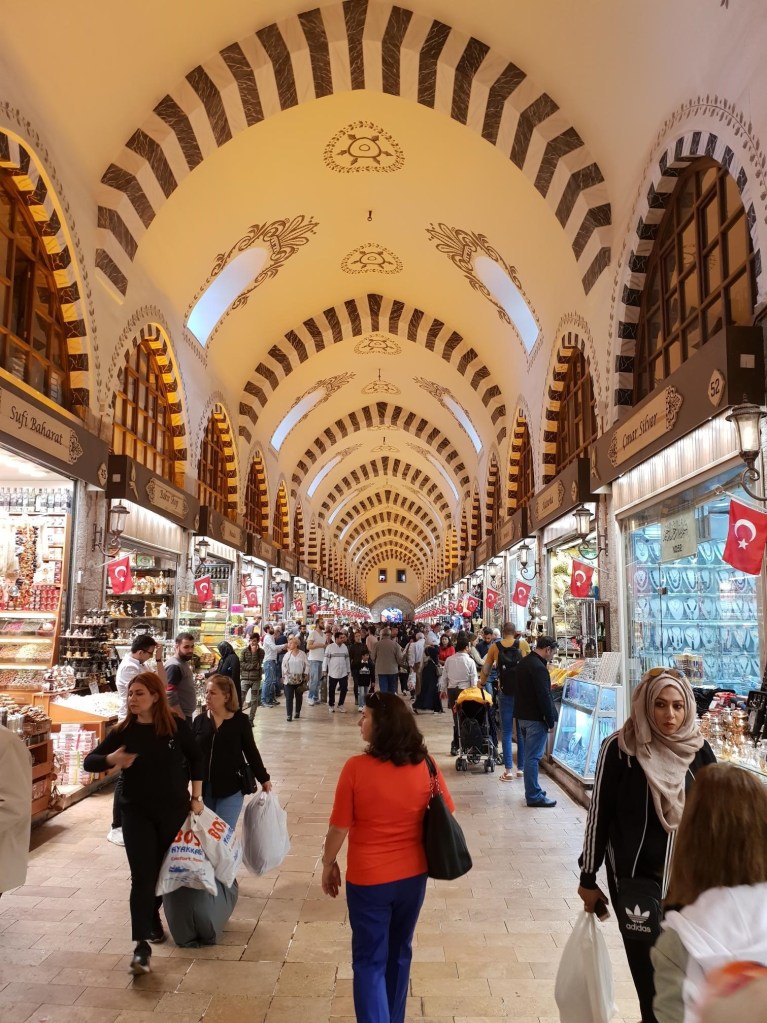
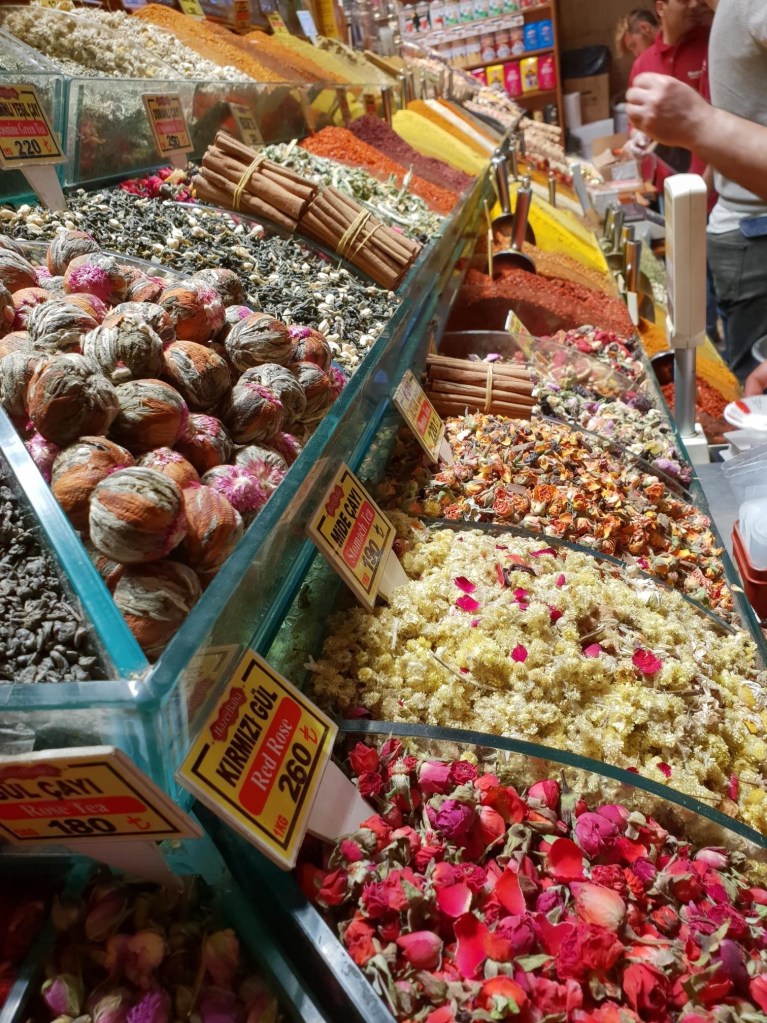
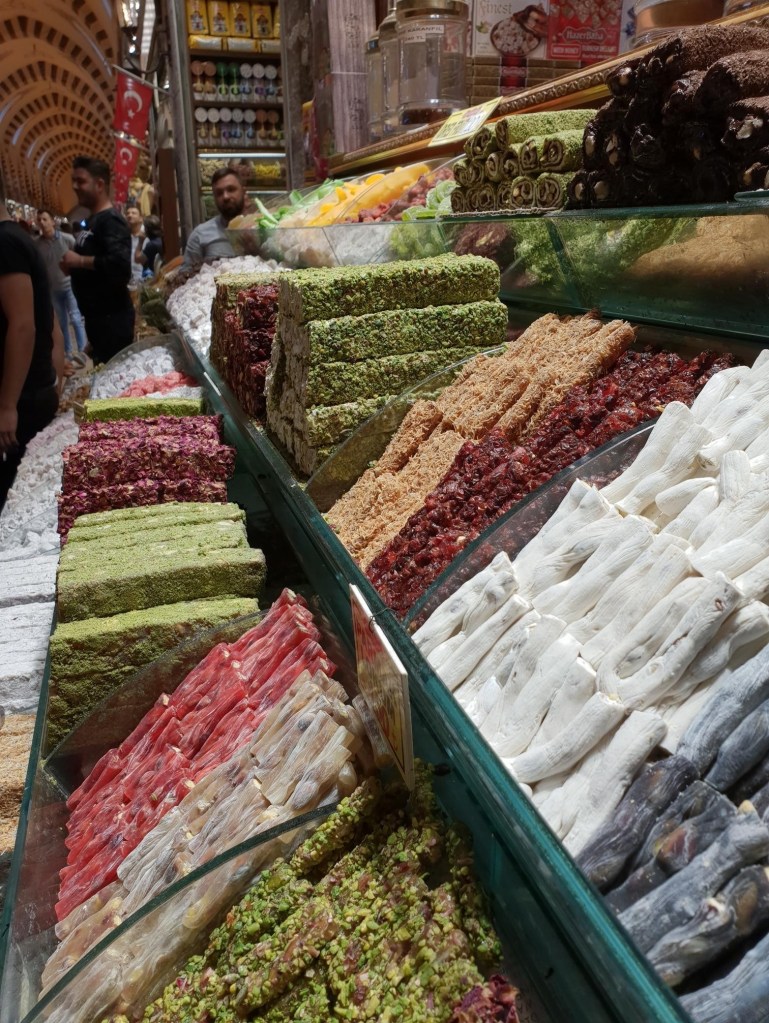
The Spice Bazar AKA the Egyptian market is adjacent to the Grand Bazaar. Not as big as the grand bazaar. However, the columns carefully shaped arches, each symmetrical to the other really spaces out the market. The coloured chandeliers along with the light, really gives the bazar a radiant feel. Each bazaar has its own character even though the same merchandise is being sold across all shops. Turkish Delight displayed across the back walls covering most colours of the colour spectrum. Whilst the front of the stores is covered by spices, pretty balls of Jasmine and dried coloured flowers. The distinct smell of the bazaar can effortlessly make you hallucinate whilst also making your wallet lighter.

The Egyptian Bazaar
Herbs and Spice on offer
The Turkish Delight on display covering all colour spectrums

Golata Towers

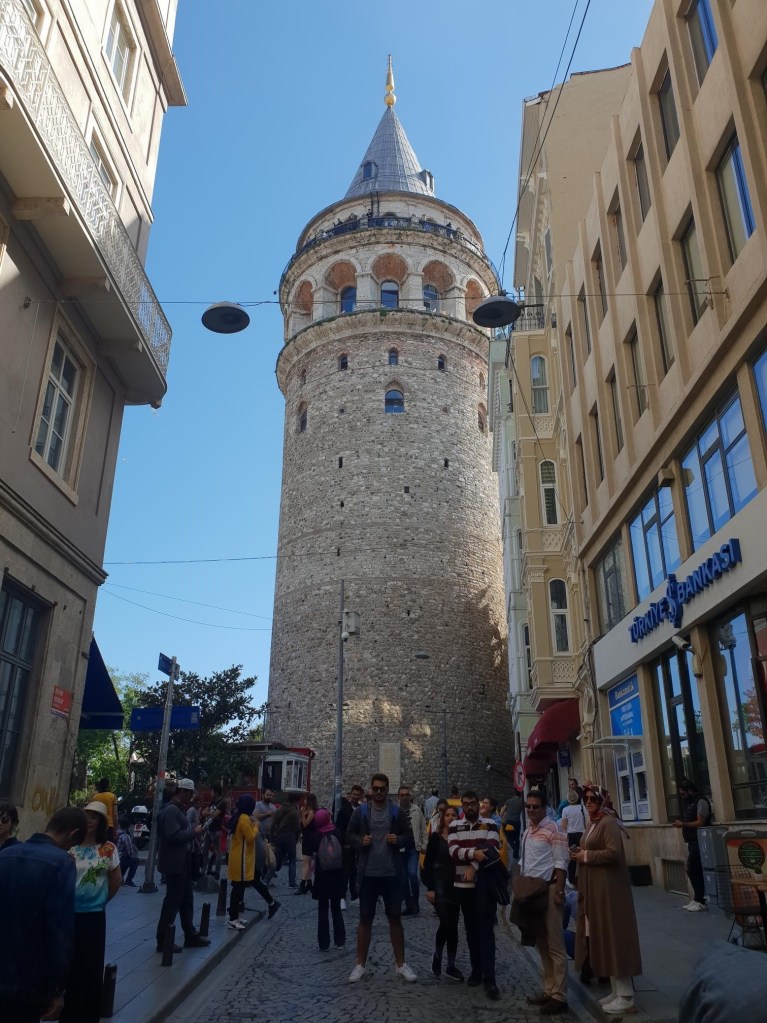
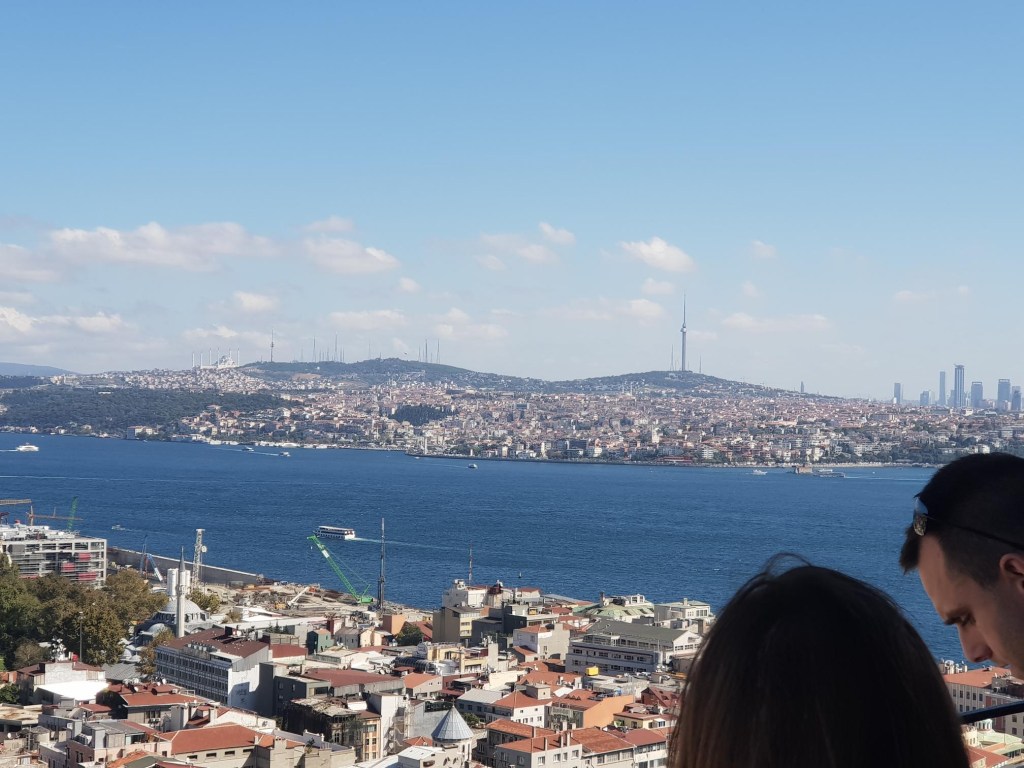
Golata Towers is practically a huge lighthouse currently aged 600-year-old. In all honesty, the brick work and roofing of the tower is spectacular. Sitting at a prominent hill top, Golata Tower imposes itself over the city, at the time it was the tallest structure in Istanbul. The purpose of the towers, was to safeguard the city of incoming threats through land and water. Most definitely worth a visit once you make it to the top. A fantastic panoramic view of the city with a restaurant inside so you can relax whilst taking in the view.

Front on view of the Golata Towers
Panoramic View of the city on top of Golata Towers

Taksim Square

Taksim square is the equivalent to Bond Street. If your missing London and are fed up of eating the local food, Taksim Square is the place. A tourist hotspot, all the retail outlets are at your peril and so are all the food chains and fancy hotels. Like most other countries outside of London most recognisable brands are considerably cheaper. I never managed to visit Taksim Square during the night, however, I was told that there are some fantastic roof top restaurants to visit. The Old tram system still runs through the city. Very similar to vintage trams which run through Lisbon. I

Food:

Now there’s a mix response in respect to Turkish food. Some people absolutely love the food and others who did not like it at all. I personally think the food lacked flavour and spices. However, the fresh fish served up well, the prices were extremely fair in accordance to the portion size. I will be sticking to my local Turkish, Istanbul next to Tooting Bec. Fantastic food with great service. Deserves a visit

  1. Meshur Eminonu Balik

Am assuming this must mean open boat fish restaurant. Well in any case, they serve a variety of fresh fish baps, which extremely tasty. I personally requested more onions and doused it with lemons. Worth a visit. Right next to Golata Bridge, not too far from Eminonu Station.

      2.Golata Bridge Restaurants

Golata Bridge has several restaurants all which serve good fish dishes. In all honesty you have to be a terrible cook to mess up a fish dish. Nevertheless, all the restaurant on Golata bridge serve the same food. Different name, same food!!

People:
Like with major cities across the world. The people are hit and miss but it would be unfair to say that the people of Istanbul represent the whole of Turkey. Some people were extremely pleasant and others who were not as pleasant.

Sufism:
Turkey is heavily influenced by Sufism; a lot art and design is Sufi inspired. Quite often tour guides will mention that the architecture of mosques and buildings, were artist and engineers inspired by Sufism. Most of the mosques are full of tombs of ‘saints’, Allah (SWT) knows best, avoid the grave worshipping as this is shirk.

Animal Friendly:

If you are an Ailurophile (cat lovers), then Istanbul is the city crying out for you. It is impossible to not spot cats in Istanbul. There are thousands walking, climbing, running and sleeping everywhere. Allhumdulilah all the cats were well fed and are extremely human friendly. The dogs are also equally treated to the same privilege.

Other recommendations:
Suleymeniye Mosque – Beautiful mosque with beautiful overseeing the Grand Bazaar and the Bosphorus River Boat tour.
Rumeli Hisari Fort – First fort which was erected by the Ottomans.
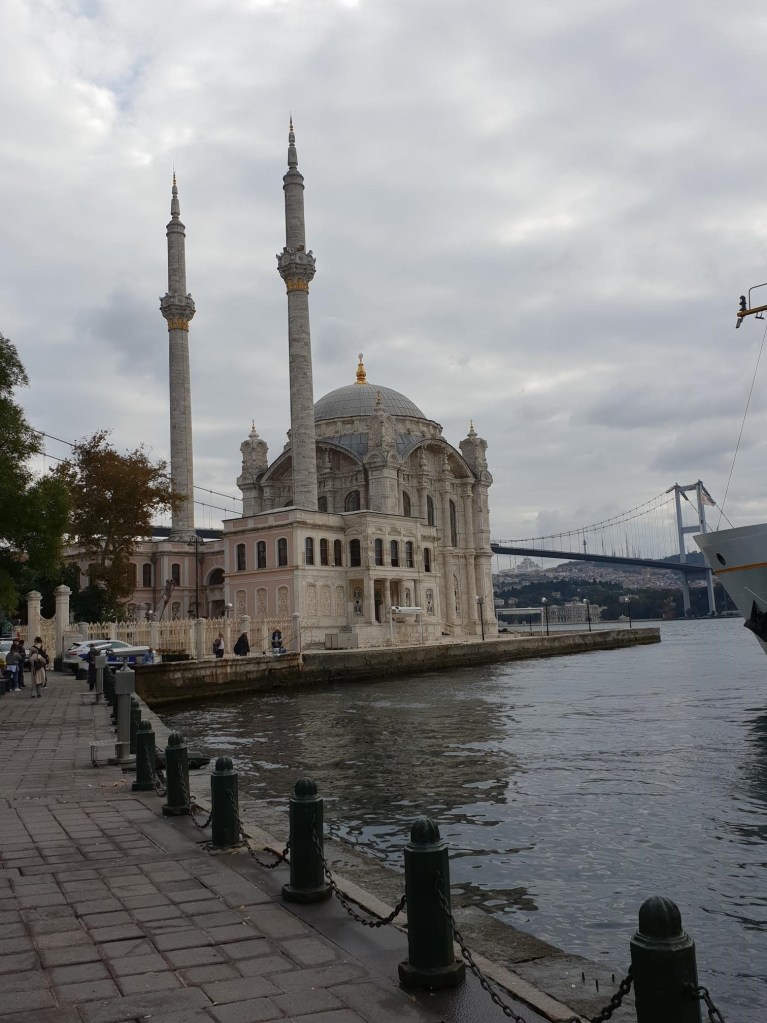
Ortakoy Mosque- A beautiful mosque on the banks of the Bosphurus. A cab journey is required.

Tips:
Keep hold of a wireless mobile charger
Walking Trainers as there is loads of walking involved
Haggle especially with the cabs always bargain 10 liras less. Uber is no longer available

Malcolm X-  A life which can engage a new generation of thinking Muslims

Featured

*This blog is dedicated to my good friend Aimal Yousafzai Khan, may Allah (swt) keep you steadfast in faith and knowledge.

*A copy of Malcolm X’s Biography can be purchased from Kindle or most bookstores.

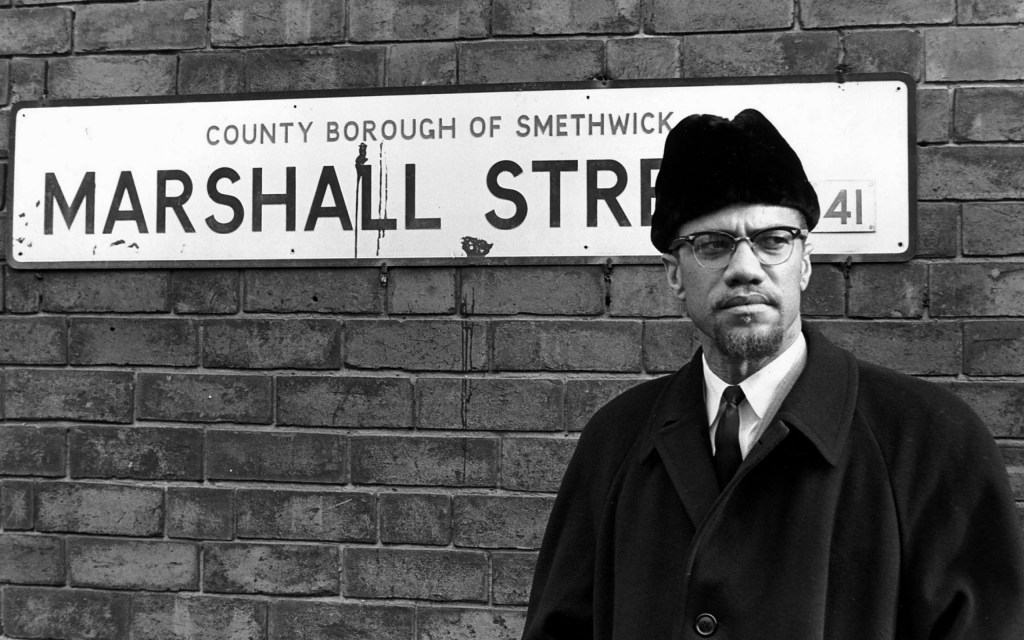
Malcolm X in the United Kingdom- Malcolm was invited to Smethwick, Birmingham to champion the right for ethnic’s to buy properties. This particular area in the UK had this problem.

The issue!!

In my observation, the issue with the modern-day Muslim is a concoction of ignorance and a lack of interest. Considering the sensitive times that we live in, one would imagine that the Muslim community should be the most pro-active thinkers in society. The rise in Islamophobia has spiked considerably since 9/11 and other terror-related incidents have further strengthened the negative stereotype of the average law-abiding citizens that wishes to co-exist in this society. 

Since the rise of Islamophobia, we are seeing a spike in the number of Islamic-hate preachers rising to prominence, individual’s like Tommy Robinson and groups far-right groups like Britain’s First have manipulated the situation to forward their own agenda. People like Tommy and Britain First have an audience that have genuine concerns about Islam. Unfortunately, the media (narrative creators) have also fuelled the fire in supporting this rhetoric. With the growing popularity of the right-wing fascist, what should young Muslim’s be doing?

 The thought process with the average human is, if it’s not on my doorstep, it is not my concern? The question is, why wait for danger when you have every chance of averting it? Considering we (Muslims) call ourselves the standard bearers, we are not as pro-active as we should be in knowing our own responsibility towards our society. 

The other issue that we have with the Muslim community, is that we either have people who excel academically or those that solely focus on Islam. Notwithstanding the above, there are Muslims within our community that can balance both, but those brothers and sisters are few and far between. 

 The wider society lacks emotional intelligence. However, in our communities, there is an endemic issue with the way we deal with one another. As a community, we are very quick to judge a person/situation, rather than taking a step back to observe the situation to find a pragmatic solution. Being judgemental is innate in all humans, however, the degree in which we make these judgments, and the way we manifest our thoughts on those judgements, is essentially the measuring stick of how judgemental we are.  

 It was not too long ago that I spoke to a well-reputed Sheikh. I had a question for the him.  After forwarding my question to the sheikh, he responded back with a question to my question. The Sheikh’s question was quite patronising as it was based on a preconceived judgement of how I look. Had it been someone who looked more Muslim, would the sheikh have answered my question straight away, or would he have asked a patronising question? I guess the latter is neither here or there? I think the greater question is, what does a Muslim look like? Maybe that’s a response for another blog. The crux of this situation Is that our youth have become disenfranchised by the learned within our community because they dress or look a certain way? 

Selective Outrage endemic!!!

The last issue that I would like to touch upon is society’s craze for celebrities. Throughout the last decade, celebrities have used social-network as their platform to address socio-political and economic issues. The Kony and the ALS Ice Bucket challenge being two that have struck out for me in recent times.. People were in their numbers sharing their outrage of Peter Kony, and millions were spent nominating five names throwing buckets of Ice Cold water over themselves, in the aid of raising awareness of ALS (Amyotrophic lateral sclerosis). Like millions of others, I was unaware of what ALS was. The question is why the selective choice of awareness?

Saying that I don’t doubt any of these celebrity’s intentions but the question remains, why do we need celebs to raise awareness? Should we not be more self-aware, or do these concerns only make sense if a celebrity champions the cause?

We as a community need to be more holistic in our understanding of the world and its problems. The issue that we currently face as an ummah,  is that we are not pro-active in our understanding of Islam, yet we want to be ‘bastions’ for our faith when it comes under criticism.

Malcolm X:

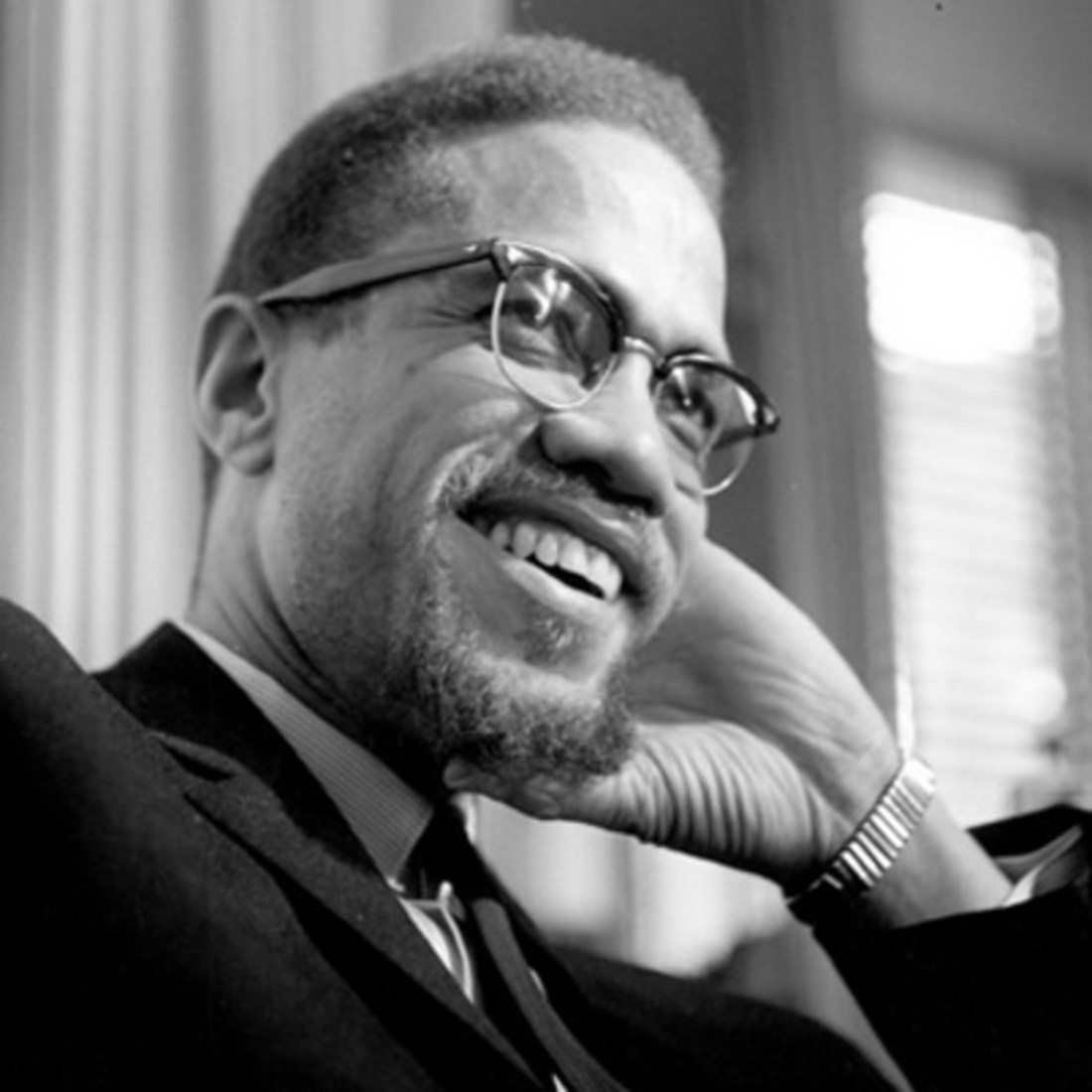
Malcolm X was a leading figure in the Civil Rights movement during 1950 to 1960s in America. Malcolm first shot to fame when he was part of the NOI (Nation of Islam), his presence had a rippling effect across the country with loads of black-African/American converting to NOI.

Considering his overreaching influence within the Nation, many within the hierarchy of NOI became envious of Malcolm’s popularity. It was not too long after, Malcolm would be ousted by Elijah Mohammed for violating orders, in respect of speaking about President Kennedy’s death.

The famous ‘chicken’s coming home to roost’ statement was an act of defiance in the eyes of Elijah Mohammed. The Chicken coming home to roost fiasco had very little part to play in Malcolm’s removal, however,  this was only a subtext to Malcolm’s removal from the nation. The fear of Elijah’s extra marital affairs was known amongst the hierarchy of the NOI (including Malcolm), if this had become common knowledge amongst his followers, people would have revolted against the NOI. And here lay the issue?

Rags to Riches?

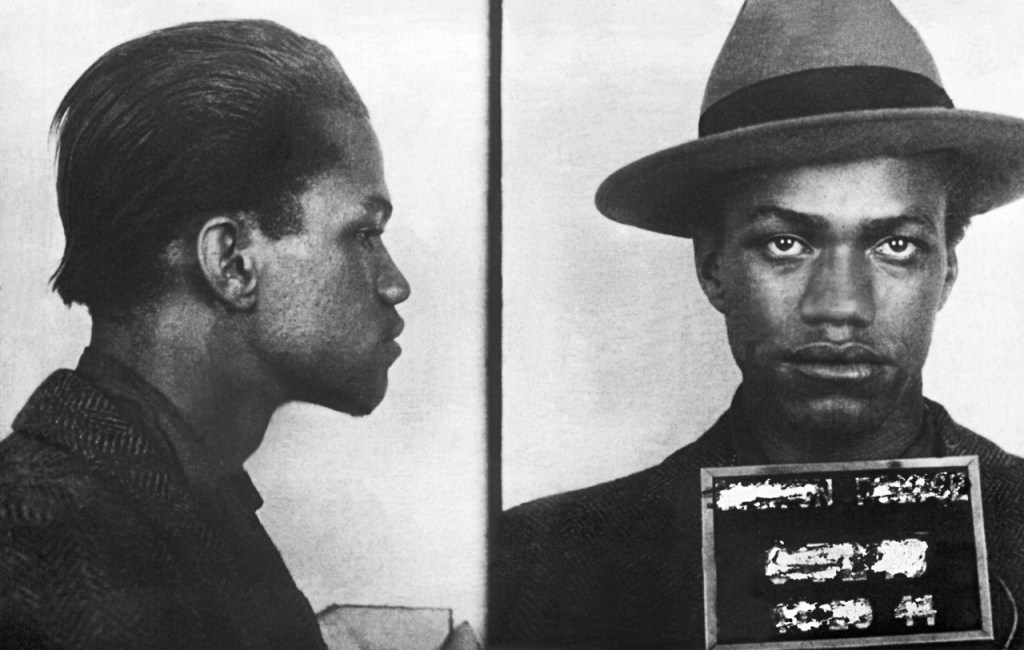
Malcolm was one of 10 children of Earl and Helen Little. Both his parents were activist against white oppression.  Whilst Malcolm was 6 his father was allegedly murdered by the black legion (white supremacist group), shortly after his father’s death, Malcolm’s mother was sectioned in a mental institute. Malcolm’s siblings were separated and they were all adopted in to different homes. Malcolm whilst adopted, excelled in school, however, he had dropped out of school at an early age; a race related incident played its part. It was not too long before Malcolm left Lansing Michigan to pursue a life in New York. Malcolm adapted to New York street life and engaged in all sorts of criminal activity, ranging from prostitution to armed robbery etc. Malcolm criminal life ended abruptly when he was sentenced to 10 years in prison for armed robbery and other such demeanours.

Malcolm Little’s sentencing

Whilst still un-repentant in prison. Malcolm came across a fellow black prisoner who was different from any black man that he had come across. This man never touched alcohol, never smoked and did not engage in worldly matters like the rest. Rather he was eloquent in speech, well informed and extremely disciplined. This man was a member of the NOI and had made a huge impression on Malcolm; it was not too long after that Malcolm embraced the NOI.

A new revamped Malcolm, with a new purpose for life; Malcolm was thirsty for knowledge. The remaining seven years of Malcolm’s time in prison was invested in reading and learning. Malcolm’s eyesight became affected by the vast volume of books he was reading, resulting in Malcolm being prescribed glasses. In addition to reading, Malcolm consciously worked on his writing skills; Malcolm’s writing style was compared to that of a professor.

After Malcolm’s release from prison. An incident had taken place in Brooklyn, in which a fellow NOI brother was assaulted by a police officer and later taken to police custody. Malcolm managed to use people power and his own influence to have his fellow brother released from prison and to be treated at a local hospital for his wounds. Never had the NYPD seen a black man have a co-ordinated influence over a group of black people in this state. Malcolm became a person of interest in New York. It would not take Malcolm too long to leave his mark on the world!

Elijah used Malcolm’s influence to forward his own agenda. Malcolm was up and down the country in lecture halls, radio station and TV studios conveying his views and debating his opinion. Through Malcolm’s efforts, the nation rapidly expanded across the U.S.  People within the nation grew envious of Malcolm’s position and it was not to long after that he would be ousted by Elijah Muhammed.

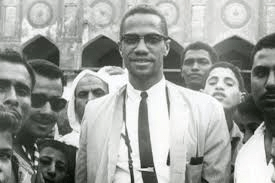
Malcolm was now out in the wilderness with his wife and four children. It had taken years for Malcolm to find something and now he was removed by this ‘divine’ man that he once loved and trusted the most. Any other person, under those circumstances, would have deviated, not Malcolm though. Malcolm went to Hajj (Saudia Arabia) to seek the real Islam. What he found was in stark contrast to the black supremacist Islam that Elijah had falsely preached.

Malcolm’s pilgrimage through the holy lands taught him that Islam has no colour-bias, prejudice or discrimination. These were only Western issues.  Malcolm’s conviction of his faith was revived and he was now a believer of the Sunnah. What also helped Malcolm was his travel through Africa. Africa taught Malcolm how rich Africa was in sense of culture, history and religion. Africa was always civilised, the imperialist masters decivilized, a civilised continent. This brought absolute resolve for an absolute man.

Re-born Malcolm X

Not too long after returning. Malcolm X movement was about black betterment through black efforts. Malcolm was now willing to work with other civil-right’s leaders like Martin Luther King to solve black issues. Prior to this, Malcolm did not engage with other prominent black civil rights leaders, as Elijah had restricted him. Malcolm also accepted that not all whites were part of the problem.

Malcolm X departs:

Elijah was not very happy of Malcolm’s new-found belief in Islam, it wouldn’t be too long before Elijah would try to silence Malcolm forever, in the fear that people would follow Malcolm towards the Sunnah. On 21 February 1965, after 16 attempts of his life in one year, Malcolm was assassinated by members of the NOI.

Malcolm’s Legacy, similarities to Umar (r.a)?

*By no stretch of the imagination would I compare Malcolm X’s life to Umar (R.A), however, it would be crazy not to observe the similarities.

For one, both Malcolm and Umar were involved in jahiliya (ignorance) lifestyle prior to embracing their respective faiths. When Malcolm and Umar (r.a) did finally embrace the faith, they were the best of followers. Their convictions in faith were unshakable and not comprisable, these men rose amongst their peers. Both Malcolm and Umar (r.a) in their respective faiths became influential figures over such a short period of time. Malcolm’s influence lead to millions following him across the USA, and Umar (r.a) influence oversaw 25 countries during his caliphate.

Ultimately Malcolm’s popularity in spreading the truth came at a price. A price which ultimately cost him his life. In one calendar year, 16 attempts were made at Malcolm’s life, one which would eventually bring an end to his life. Both Malcolm and Umar would be martyred.

Malcolm’s death, nearing similarities to Uthman (r.a) death.

Uthman (r.a) was martyred in his own house. The murder of Uthman was writing on the wall. Muhammed (PBUH) prophecised that Uthman (r.a) would be martyred whilst he was a leader. Years from that prophecy, Uthman (r.a) would be martyred by his own people. Uthman could have survived the plot as the whole of Medina would have protected him, however, he refused to divide an Ummah and refused to be the reason of initiating the first fitnah in Islam. The brutal murderers eventually had taken Uthman’s (r.a) whilst he was in his house.

If we were to examine Malcolm’s death you could draw similarities to Uthman’s (r.a) death. Once again, the time, reason and situation for the two deaths are worlds apart. What we can extrapolate from these two great individuals, is that they did not fear their death and their belief (Imaan) was unshakable even from death itself. Malcolm was in the middle of a lecture when three men from the NOI had sprayed several bullets through Malcolm. The impact of the shots resulted in Malcolm being pronounced dead at the scene of the incident. What is fascinating about this situation is that Malcolm could have prevented his own death. However, Malcolm refused to have anyone searched which ultimately resulted in his death.

Those closest to Malcolm realised that he felt that the end was near. A week prior to his death, Malcolm declared himself a dead man on a radio station. Similarly, Uthman (r.a) himself had a dream in which Muhammad (PBUH) had invited him to break bread with him, Umar and Abu-Bakr (r.a). It is evident that both martyrs were relentless in their belief and were not in fear of being murdered.

How many players do you know?

Going back to the beginning, a lot of the role-models in today’s society are people within the entertainment industry. Other than filling their own pockets and providing entertainment, what have they provided for the betterment of society? The question I always ask the brothers who have an interest in football, how many players do you know from your football team and where do they come from? Then pose the next question, how many sahabas do you know and what were their qualities?

This is not a superiority contest of Islamic knowledge, rather it is a way to reflect; as to where we are, and where we need to be.

What is my proposal?

My issue has always been the celebrity craze that we all follow. It would also be a lie to say that am also subject to this as well.

For the mentioned reasons.  I would propose that Muslims should make an active engagement in reading. Reading is quintessential to the existence of a Muslim. There is wisdom behind reading; not only does it enhance your understanding but it also reduces our ignorance.

Allhumdulilah, our primary source is the Quran. However, Allah (SWT) also instructs us to learn from our brothers in humanity (people of all faiths and non-faiths). When we learn from our brother’s; it is important to take the good and reject which is bad from them.

The first verses revealed to Muhammed (PBUH) was Iqra (read). Now the word Iqra is mentioned twice in this verse. Allah (SWT) orders Muhammad (PBUH) to seek knowledge from the Quran and man himself.  This verse goes back to what I was mentioning earlier in this blog. We as Muslims either go one way or the other. It’s either we lose ourselves in the dunya (world) or we overburden ourselves with the deen.

There is nothing worse than a person who is ignorant. For when an ignorant person is provided with the Haq (truth) he will still appeal to cognitive dissonance or illogical fallacy. A seeker of knowledge will never turn away from the truth.

Brother Malcolm X in the last ten years of his life achieved so much because he wanted to make that change. His life is a lesson that we can all strive for greatness should we make the effort. Granted we may not scale the same heights, but we can make a conscious effort of making that change. If, every one of us, was to make the effort to change, as a community we could achieve great things, whilst also bridging the gap within our communities.

I often hear a lot of Muslims saying, ‘it is too late for me am old now’ or ‘I have sinned too much’. Brothers and Sisters look at the lives of Malcolm X and Umar (r.a), they both found their path’s in their 30’s, surely this is a sign, that too late is never.

To all our younger brothers who are still impressionable. Do not feel like you have failed. Continue to enjoy your life to the fullest but be steadfast in your belief and never stop reading and searching for the truth.

Let’s not resort to violence and forward the media narrative. Let our actions and mouths speak the kindest and wisest of words so that we can change the hearts of those who have ill-feeling towards our faith. The golden years were only successful because the Muslim’s were the best amongst the knowledgeable in all aspects of life. They never limited themselves to one understanding, they could accommodate their understanding across various sects of society to spread the message. Malcolm X is the perfect example of a 20th century Muslim, who had his fair share of 20th-century struggles and could change it around in all fronts.

 Please Share if this has benefitted you or you feel will benefit others.

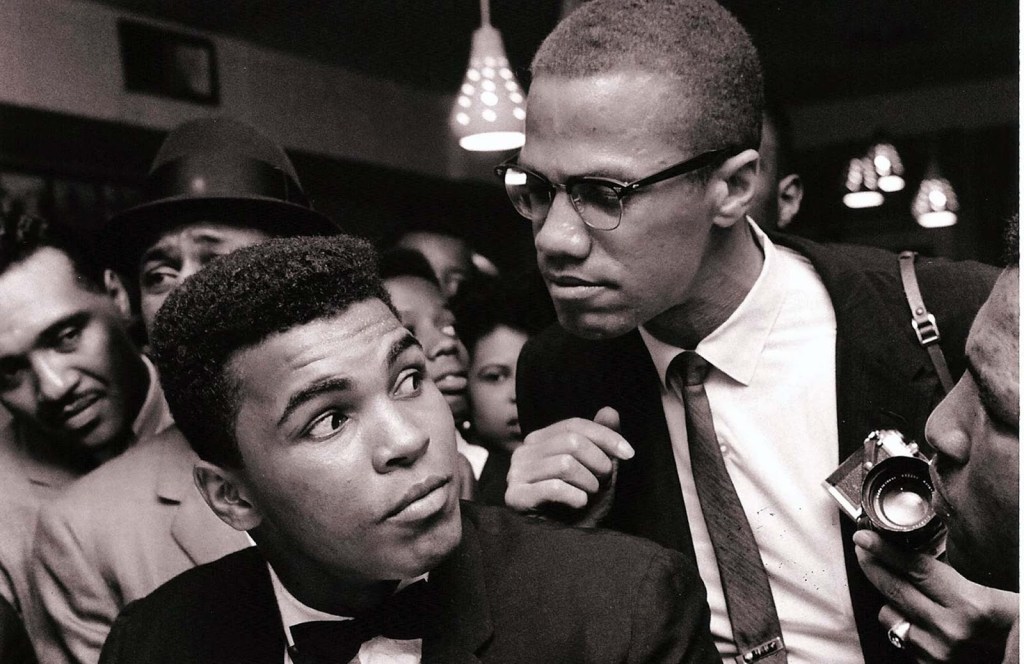
Muhammed Ali’s mentor